

My daughter’s first pool trip lasted exactly four minutes before she lost it — full-body screaming, the kind where other people at the pool start looking around for whoever’s hurting a child. Then, weirdly, she went quiet, looked down at the water around her belly, and smacked it with both hands like she’d invented percussion. That was it. We were pool people now.
I tell you that because I want to be honest about something nobody says out loud enough: babies flip from terrified to obsessed with almost no warning, and you have to be ready for both. I spent that whole first outing gripping her under the arms so hard my fingers cramped, half-convinced I was one distracted second away from disaster. I wasn’t overreacting. Water really is one of the only places in early parenting where “be careful” isn’t just a nervous parent thing — the stakes are exactly as high as they feel.
So if you’re staring down a first pool day, or you already did one and came home more rattled than relaxed, this is the stuff I actually wish someone had told me instead of the vague “just watch them closely!” advice that’s everywhere.
Okay, But When Can Babies Actually Go in the Pool?
Somewhere around 6 months is the number most pediatricians land on, mostly because that’s when babies finally have decent head and neck control and can hold themselves a bit more upright. Before that, don’t bother — their little bodies can’t regulate temperature well, and water that feels perfectly warm to your hand can chill a small baby uncomfortably fast.
Here’s what I got wrong the first time: I assumed “ready for the pool” meant “ready to kind of do her own thing.” Nope. A 6-month-old in water is cargo. You’re the boat, the life raft, and the entertainment director, simultaneously.
A few things I’d tell my past self:
- Ten to fifteen minutes is genuinely enough for a first session. Longer isn’t a flex.
- Go for a heated pool, or at least one that’s been baking in the sun for a while. Cold water plus a baby is a fast track to a miserable, screaming exit.
- Blue-ish lips or shivering means you’re done, immediately, no “just five more minutes.”
Swim Diapers Aren’t Optional (Learned This the Gross Way)
I once put a regular diaper on my son for what I thought would be a quick dip. Within maybe ninety seconds it had absorbed half the pool and turned into something resembling wet cement hanging off him. Never again.
Swim diapers don’t absorb — they’re built to just contain solids and let water pass through, which sounds unpleasant when you say it out loud but is honestly the whole point. Most public pools require them anyway, so you don’t really have a choice, but even at a private pool, do yourself the favor. If your kid tends to have blowouts, double up with a reusable swim diaper underneath a snug suit. Not cute. Very effective.
Floaties Are Toys. Say It With Me.
I’m going to be a little blunt here because I think this matters: those puffy arm floaties everyone’s kid wears? Toys. Not safety gear. I know they look official with their bright colors and inflation valves, but they can slip, they can pop, and worse, they make parents relax at exactly the moment they shouldn’t.
If you actually want flotation support, get a proper Coast Guard-approved infant life vest — the kind with a crotch strap and a collar behind the head that keeps their face up even if they go still. Puddle jumpers are a reasonable step up for toddlers who are old enough to be actively kicking and moving, but even those need an adult close enough to grab an arm in one motion.
None of it replaces you being right there. I mean that literally, not as a scare tactic — devices give a false sense of “handled,” and that’s exactly when things go sideways.
What Watching Your Kid In A Pool Actually Looks Like
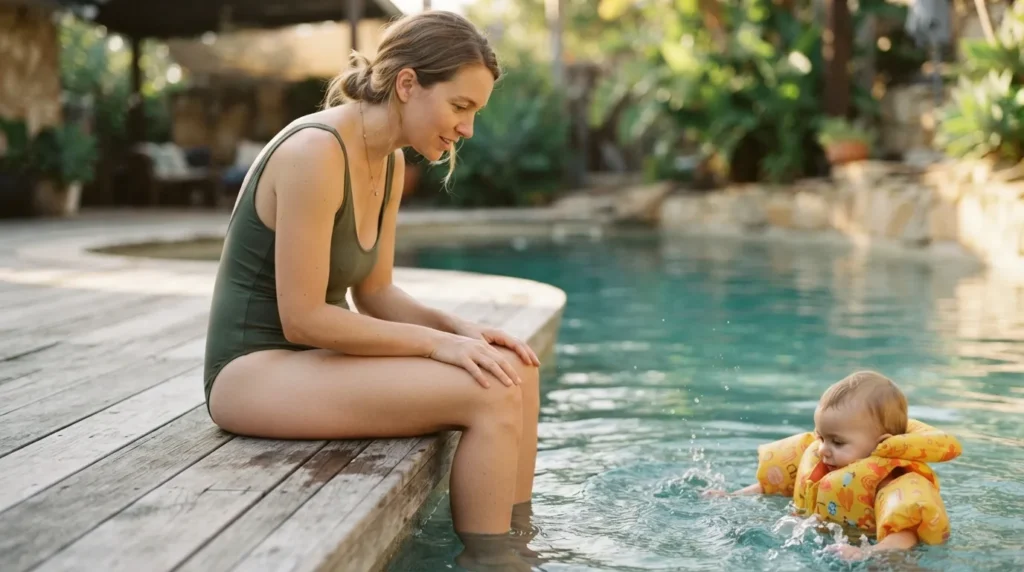
Here’s the thing people get wrong constantly, myself included in the early days: supervision isn’t sitting on a lounge chair glancing over every so often. It’s arm’s reach, eyes on, the whole time. No phone. No “just checking one text.”
Drowning isn’t loud. It isn’t the dramatic splashing-and-yelling thing you see in movies — it’s fast and it’s quiet, and a baby can go under in the time it takes to reply to a group chat message. If you’re at the pool with other adults, pick one person to be the actual watcher — not drinking, not scrolling, not deep in conversation — and swap that job every fifteen or twenty minutes so nobody’s attention just quietly fades out.
Sunburn Sneaks Up Faster Than You’d Think
Pool days mean hours in direct sun, usually right when it’s strongest, and baby skin has basically no defenses. For anyone under 6 months, most dermatologists say skip sunscreen entirely and lean on shade, hats, and lightweight UPF clothing instead.
Past 6 months, a mineral sunscreen made for babies is fine, but reapply after every swim — “water-resistant” is doing a lot of lying on those labels. A wide-brim hat and a rash guard genuinely do more work than people give them credit for, and it means less sunscreen wrestling with a squirmy baby who has opinions about lotion.
Water Temperature and That Chlorine Rash Nobody Warns You About
Babies lose body heat way faster than adults — less fat, more surface area relative to their size — so a pool that feels fine to you can be genuinely too cold for them within minutes. If you have any say in it, aim for somewhere around 84 to 87 degrees for babies under a year. A lot of indoor baby swim programs keep their pools right in that range for exactly this reason.
Chlorine can also do a number on sensitive baby skin — my daughter got a faint pink rash on her thighs after a couple of pool visits that took me embarrassingly long to connect to the chlorine. Rinse them off with fresh water right after swimming, and keep an eye out for redness that shows up later in the day. If it keeps happening, a saltwater pool tends to be gentler on skin like that.
Are Baby Swim Classes Worth It?
Plenty of parents swear by them, and I get why. To be clear, babies aren’t developmentally capable of anything close to real self-rescue until closer to age 4, so these classes aren’t teaching your infant to “swim” in any meaningful sense. What they actually do is build water comfort — teaching babies to hold their breath reflexively when their face gets splashed, and giving you supervised practice handling them safely in water.
I’d frame it less as swim training and more as confidence-building, for both of you. A decent instructor will also show you handling techniques you can carry straight into bath time, which, honestly, is where a lot of drowning risk quietly lives without anyone thinking about it that way.
Before You Walk Out the Door
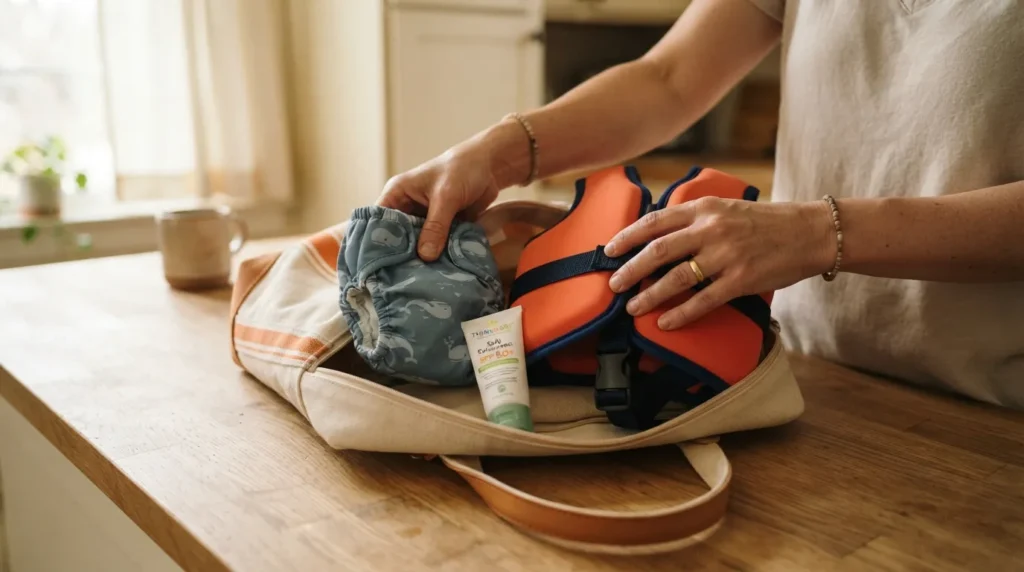
Run through this fast:
- Swim diaper on, swimsuit over it
- Sunscreen or UPF clothing, depending on their age
- Actual life vest packed, not just floaties
- A designated watcher if there’s more than one adult around
- Water temp checked if you can control it
Takes two minutes. Saves you from scrambling poolside with a cranky baby and a bag full of half-packed towels, which — trust me — is not the moment you want to realize you forgot the sunscreen.
Last Thing
Pool days really are one of the best parts of having a baby — that first stunned, delighted look when they realize water holds them up is worth every bit of the nervous hovering. But the fun and the vigilance have to sit side by side, not take turns. You don’t need to be a nervous wreck about it. You just need to be the one adult who never stops actually watching.
That’s genuinely the whole thing. Not a laminated checklist, not something you master once and move on from — just staying close, paying attention, and letting your baby do the rest. Which, based on my experience, mostly involves shrieking with joy and slapping the water like it personally wronged them.