
I remember standing in my kitchen at 2:14 in the morning — I checked the clock, that’s how I know the exact time — bouncing my son while he gnawed on my collarbone like it owed him money. My shirt was soaked through with drool. I had a browser tab open titled “is teething actually this bad or is something wrong with my baby,” and eleven other tabs behind it that I’d already given up on. If any of that rings a bell, welcome. You’re in it.
Nobody really prepares you for how physical teething is. Not for the baby — for you. The clinginess, the way they’ll only sleep on your chest, the fact that a perfectly happy kid turns into a tiny gremlin the second a molar starts pushing through. Some of the remedies people swear by are genuinely useless. A couple of the popular ones are actually dangerous, which nobody tells you until you’re the one googling it at 2 a.m. So here’s what I’ve actually seen work, across two kids with wildly different teething experiences.
Wait, Is This Even Teething?
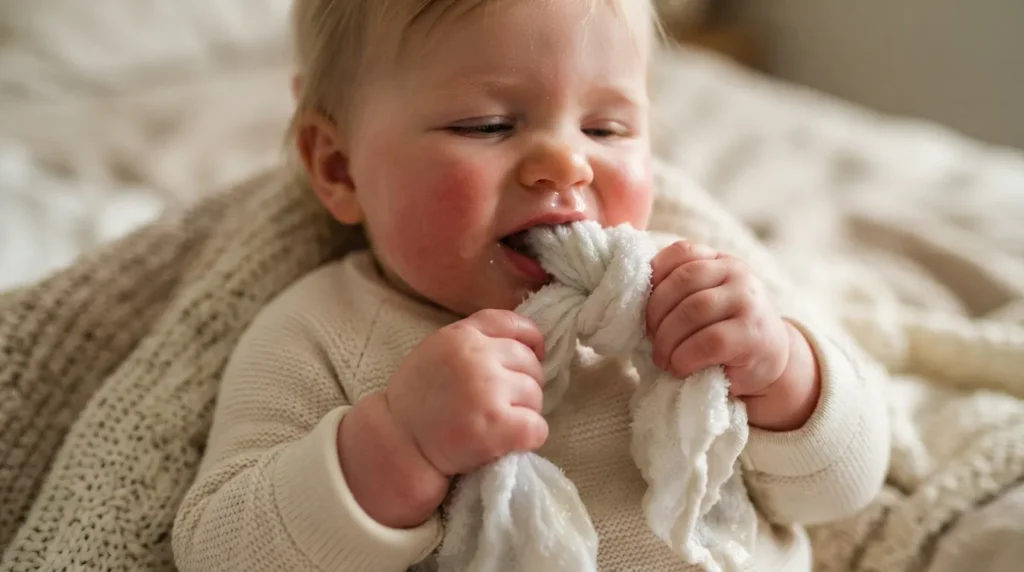
My daughter cut her first tooth at four months without so much as a whimper. I found it by accident, running my finger along her gums while she gnawed on it. My son didn’t get his first tooth until he was almost one, and when it finally showed up, we had two straight weeks of a baby who screamed every time he was laid flat. Same parents, same house, completely different kid.
The real signs are drooling that soaks through burp cloths faster than you can swap them, chewing on absolutely everything (fingers, toys, your shoulder, the dog), and gums that look puffy or a little bruised right where the tooth is coming through. A mild temperature bump can happen, but a real fever — 100.4°F or higher — usually isn’t teething. Neither is diarrhea, a rash, or a runny nose, no matter what your aunt insists. If you’re seeing those, call your pediatrician instead of waiting it out.
Cold, Cold, and More Cold
This is the one that actually holds up. Cold does two things at once: it numbs the gum a little and the pressure pushes back against that ache of a tooth trying to break through skin.
What’s worked in our house, in order of how often I reached for it:
A damp washcloth, twisted into a rope shape, tossed in the freezer for about 20 minutes. Cheap, always available, and my kids both went absolutely feral for it.
Silicone teething rings — the fridge, not the freezer. Freezer-hard silicone can actually bruise sore gums, which feels counterproductive when the whole point is comfort.
For babies already on solids, a mesh feeder with frozen banana or mango buys you a solid fifteen minutes of peace and quiet. I will die on this hill.
Skip anything with liquid gel inside the ring. They crack. I learned this the hard way, cleaning weird blue goo off a high chair tray and wondering if it was toxic (it wasn’t, but I never bought another one).
Just Your Finger, Honestly
This one feels almost too simple to mention, but wash your hands and gently rub baby’s gums in small circles, right where you can feel the tooth working its way up. It’s not glamorous. It’s not going to show up on a “top 10 teething hacks” list. But it works, and it costs nothing.
I did this constantly with my son during his rough stretch, usually at 3 a.m. with him draped over my shoulder like a very unhappy sack of potatoes. It didn’t fix everything. But it was often the difference between a baby who eventually settled and one who screamed for another hour.
The Stuff I Want You to Actually Avoid
I’m not going to hedge on this part, because it matters.
Amber teething necklaces — please don’t. They’re a strangulation risk and a choking risk if they break, and there’s no real evidence they do anything for pain. I know they’re marketed as this natural, gentle option. They’re not worth it.
Homeopathic teething tablets and gels with belladonna — these got flagged by the FDA years back for inconsistent, sometimes dangerous amounts of the ingredient, and there were reports of real harm to infants. If you see them on a shelf, that doesn’t mean they’ve been deemed safe. Skip them.
Benzocaine gels, the Orajel-type products — not recommended under age two. There’s a rare but serious risk of a condition called methemoglobinemia that messes with how blood carries oxygen. I know the instinct to numb the pain fast is strong. This isn’t the way to do it.
For the Genuinely Bad Nights
Sometimes cold cloths and gum rubs aren’t enough, and that’s fine — that’s what infant acetaminophen or ibuprofen (only after 6 months for ibuprofen) is for. This isn’t a “give it preemptively just in case” situation. It’s for the nights when your baby is clearly in real pain and nothing else is touching it.
Dose by weight, not age — check with your pediatrician or read the label carefully. This part matters more than people think, and it’s an easy thing to get wrong when you’re exhausted and just want your baby to stop crying.
Feeding Gets Weird for a Bit

Both of mine went through phases where they basically refused to eat during a bad teething stretch, especially anything involving sucking, since that puts direct pressure on sore gums. If you’re nursing or bottle-feeding, a slower-flow nipple or shorter, more frequent sessions can help. For babies on solids, cold food — applesauce straight from the fridge, chilled yogurt, mashed banana — tends to go over better than the usual room-temp stuff.
Don’t panic over a few days of a smaller appetite. It comes back. It always has for us, usually within a day or two of the tooth actually breaking the surface.
When It’s Genuinely Not Teething Anymore
Call your pediatrician if there’s a real fever, unusual lethargy, diarrhea, a rash, or your baby is refusing all food and drink. Teething is uncomfortable, but it shouldn’t cause those things — if you’re seeing them, something else is going on, even if a tooth happens to be coming in at the same time.
You know your baby’s version of “off” better than any article does, mine included.
The Part Nobody Puts in a Neat Little Box
There’s no single trick that makes teething painless, and I’d be lying if I told you otherwise. What actually gets you through it is a rotating mix of cold pressure, finger rubs, the occasional dose of pain relief on the truly bad nights, and an amount of patience you didn’t know you had until you needed it.
It ends. Every single time, for us, it ended — usually right around when I’d convinced myself this particular tooth was going to be the one that broke me for good.