

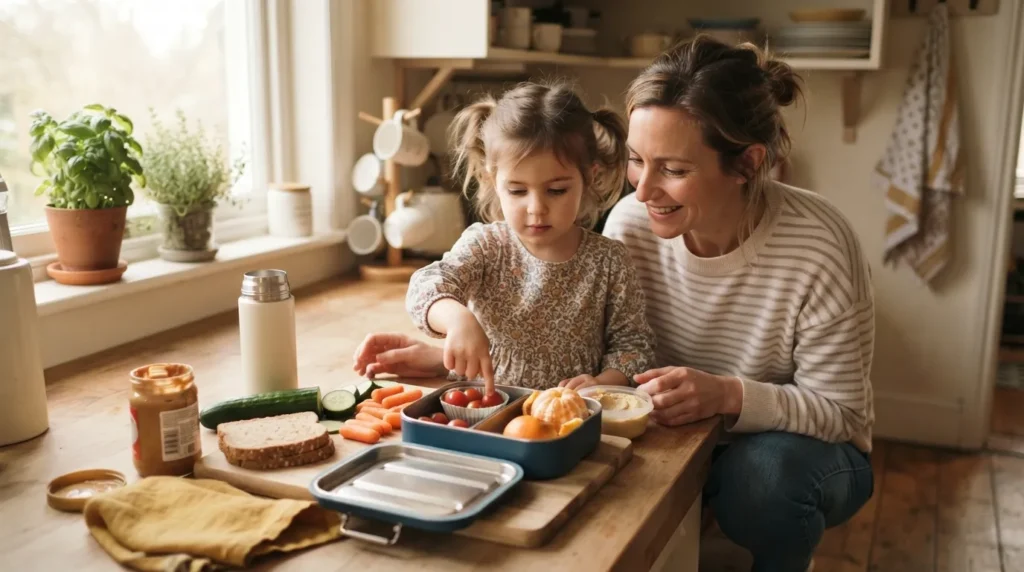
My friend Priya called me at nine at night, which is how I knew it was bad. Her son had come home from school that day and asked if they could “just do sandwiches” for lunch from now on. Not because he didn’t like dal. He loves dal, has since he was two and used to eat it with his hands before he could hold a spoon properly. A kid at his table had asked, loud enough for the whole cafeteria, “what IS that smell?” And that was it. Eight years old, and he wouldn’t even look at her when she tried to talk about it at bedtime. Just stared at the ceiling and said, “Can we just do sandwiches.”
I’ve been there in some version or another. Not the exact lunch, but the exact feeling — that gut-drop when your kid starts quietly editing themselves to fit somewhere you can’t fully follow them into. Nobody warns you about that part. You spend so much energy on the visa paperwork and the accent and figuring out where to buy the right spices that you don’t clock, until it’s already happening, that your kid is going to have to do their own version of that adjustment. Except they’re seven. And they’re doing it in a cafeteria.
I don’t have a tidy fix for that ache. What I have is almost fifteen years of raising two kids across two cultures, plus a lot of late-night phone calls with other parents doing the same thing badly, together. So here’s what’s actually held up.
Your Kid Isn’t Rejecting You. They’re Just Trying to Get Through Lunch.
The first instinct — and I mean the very first, before you’ve even had coffee — is to take it personally. Your kid doesn’t want the food you made, doesn’t want to speak the language you speak, suddenly finds the thing you love embarrassing. It feels like rejection because it lands right in the chest, same spot.
It almost never is rejection, though. It’s a kid trying not to get singled out. That’s just what childhood does to people — you want to blend into the wallpaper, not stand out as “the one with the weird lunch.” A seven-year-old rejecting your cooking at 7am isn’t making a statement about heritage. He’s trying to survive homeroom.
So skip the speech about being proud of where you come from. Save it — you’ll need it later, and it lands better when it’s not being deployed as damage control. In the moment, something smaller works better: “That kid was rude, not you. What do you want to bring tomorrow instead — let’s pick something you’re actually excited about.” You’re not caving to assimilation. You’re just choosing not to fight this particular battle over a sandwich.
The Language Thing Is Going to Drive You Slightly Insane, and That’s Normal
I have talked to more parents than I can count who are ready to throw in the towel because their kid understands the home language perfectly and answers back in English every single time, like clockwork, like it’s a bit. It is maddening. I lived through a solid three-year stretch of it myself.
Here’s the part that actually helped me stop spiraling: comprehension almost always survives even when the talking-back stops. Keep speaking your language at home regardless of what comes back at you. Don’t cave and switch to English just because it’s easier in the moment — I did that for about two weeks once, out of sheer exhaustion, and I regretted it almost immediately because my daughter noticed and started testing the boundary constantly.

A few things that genuinely moved the needle for us:
- Movies and shows in our language, no subtitles, even when they groaned about it
- Video calls with grandparents — my kids will speak for forty-five straight minutes to their grandmother in a language they claim to “not really speak”
- Biting my tongue instead of correcting every mispronounced word mid-sentence, because nothing shuts a kid up faster than being fixed constantly
And for what it’s worth — I’ve watched teenagers who barely spoke a word of their family’s language at ten pick it right back up in their twenties, once it became something they wanted for themselves instead of something imposed on them. It’s not gone. It’s dormant.
Explain the Why. “Because I Said So” Doesn’t Travel Well.
A lot of us grew up on “because I said so” as a complete, non-negotiable sentence, and it worked, because the whole neighborhood was reinforcing the same rule anyway. That backup system doesn’t exist here in the same way. Your kid’s friends are running on entirely different house rules, and they will report back on it, gleefully, at dinner.
This is where a real reason beats a repeated no. “We don’t do sleepovers, end of discussion” invites a fight. “We’re careful about sleepovers right now — here’s what worries me, and here’s what we can do instead, like a late pickup or a video call before bed” invites a conversation. You don’t owe your nine-year-old a full debate on every rule in the house. But a short honest reason lands very differently than a flat wall, especially once they’re old enough to notice that other families operate differently.
When “But Her Mom Lets Her” Comes Up
It will come up. Constantly. And it’s not betrayal — it’s just a kid clocking that families vary. You can hold your line without making them feel silly for noticing: “Every family decides differently. This is what we’ve decided, and here’s why.”
Holidays Will Test You More Than You Expect
Nothing surfaces the tension faster than December, or Ramadan, or Lunar New Year, running smack into a country whose entire calendar is built around somebody else’s holidays. My kids spent about three straight years lobbying hard for a Christmas tree, because every single classmate had one and they felt left out of a very specific kind of magic.
We got one. I want to be honest that this surprised some relatives back home. But a tree with lights on it didn’t threaten anything I actually cared about passing down, and it let my kids feel like part of the world around them without giving up a single thing that mattered to us underneath it. Figure out, ahead of time if you can, which traditions are truly non-negotiable in your house and which ones are just habit dressed up as principle. That’s not losing anything. That’s just knowing the difference between a hill worth defending and one that isn’t.
Find Your People, Even If It’s Just Two of Them
Kids need proof, not just reassurance, that their family’s way of doing things is normal somewhere — that it’s not just “your weird house rules,” it’s an actual way of living that other people share. If you can find even a small handful of families from a similar background, hang onto them. Weekend cultural school, a group chat of parents who don’t need the backstory explained, shared meals where nobody asks what’s in the pot — these do more work than they get credit for.
It helps you too, honestly, more than I expected it to. There’s a specific kind of tired that comes from parenting across two cultures at once, and it’s hard to explain to someone who’s never translated a school permission slip and a proverb in the same breath. Having even one friend who just gets it, without the footnotes, changes the whole texture of the week.
Let Them Be Both. Fully. Not a Percentage of Each.
The best outcome isn’t a kid who eventually picks a side. It’s a kid who learns to carry both without apologizing for either — sandwiches on Tuesday, dal on Thursday, no shame attached to any of it. That takes years to build, and it starts with you modeling it first. If you’re constantly downplaying your own accent, your own food, your own customs, your kids will absorb that faster than any speech about pride ever could.
A year after that cafeteria incident, Priya’s son brought a friend home and made him try dal, narrating the whole recipe like he was hosting a cooking show. Kids circle back to the things that once embarrassed them — usually right around the moment they realize those things were actually the cool part all along. You don’t need to prevent the embarrassed phase. You just need to still be standing there, unbothered, cooking the same dinner, when they come back around to it.