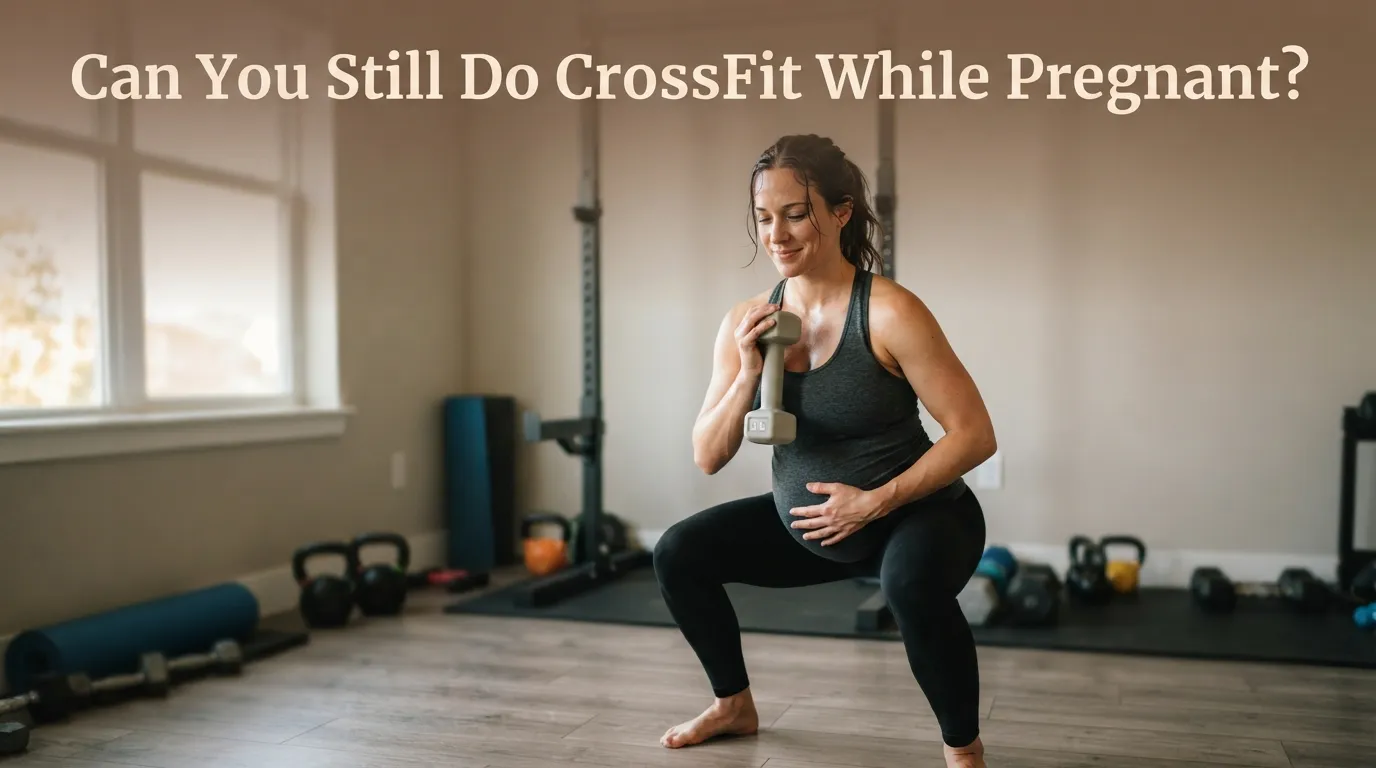
Six weeks pregnant, nobody told, standing in the middle of a WOD trying to decide if I should scale the box jumps or just quietly skip them and hope nobody noticed. That was me, staring at a whiteboard full of thrusters and pull-ups, doing math I had no training for. My coach thought I was just having an off day. I was not having an off day. I was terrified I was about to make a decision that would hurt my kid before I’d even met them.
If you’re two lines into a pregnancy test and wondering whether your gym membership just became a very expensive coat rack, I get it. I’ve asked every version of this question myself, across two pregnancies, and the answer isn’t as scary as it feels at 6am with your heart still pounding from a workout you’re now second-guessing.
So, Can You Actually Keep Doing CrossFit?
Mostly, yes. I know that’s not the dramatic answer people expect, but for most healthy pregnancies, staying in the gym is genuinely one of the better things you can do for yourself. The old idea that pregnant women need to lie low and keep their heart rate under some magic number has been out of date for years now, and frankly it never made much sense to me anyway — women have been doing physical labor through pregnancy for all of human history.
Here’s the catch, and it’s a real one: this only holds if you were already doing CrossFit before you got pregnant, and if your pregnancy is considered low-risk. This isn’t the moment to start CrossFit for the first time because you saw someone doing snatches at 32 weeks on Instagram and got inspired. That’s a different conversation entirely.
I’ll also say this plainly, because I think it gets glossed over — some days you’re going to walk into the gym and everything feels wrong. Your energy’s gone, your wrists ache, the smell of the chalk makes you nauseous. That’s not weakness. That’s pregnancy. Skip the workout. It’ll still be there tomorrow.
Have the Actual Conversation With Your Provider
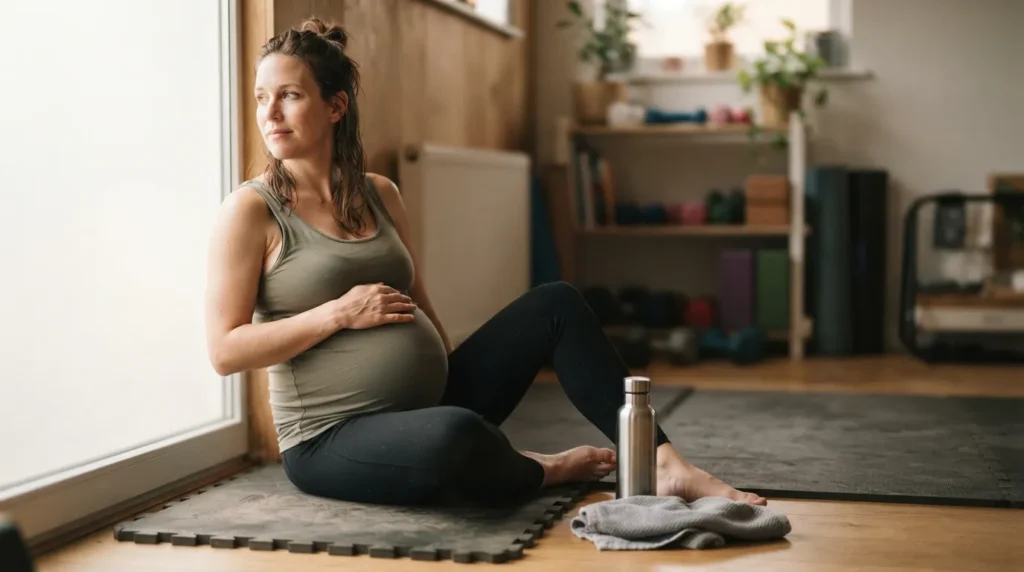
Not the vague one. Don’t ask “can I work out while pregnant” and accept whatever generic pamphlet answer comes back. Sit down and describe what you actually do — the cleans, the volume, how many days a week, whether you’re chasing weight on the bar or just moving. My OB with my first pregnancy barely blinked. With my second, she asked a lot more questions because of something in my bloodwork, and that changed my whole approach for a few months. Both were the right calls, for two very different pregnancies.
If you’ve got something going on — placenta previa, a history of preterm labor, preeclampsia risk, anything like that — everything below takes a back seat to whatever your provider tells you directly. No blog post, mine included, outranks that conversation.
What Actually Changes, Trimester by Trimester
First Trimester: Mostly Business as Usual
Early on, a lot of women keep training close to normal, aside from the fatigue and nausea that have nothing to do with fitness and everything to do with your body building a placenta from scratch, which, when you think about it, is kind of wild. Your joints are stable, your balance hasn’t shifted, nothing physically stops you yet.
The thing nobody warned me about was heat. You run hotter when you’re pregnant — your resting body temperature climbs a bit — so this is when I started paying real attention to hydration and avoiding the box on the brutal afternoons. I learned this the hard way after a July WOD left me lightheaded in the bathroom for twenty minutes. Not my finest hour.
Second Trimester: This Is Where It Gets Real
Somewhere around 16 to 20 weeks, things shift. Your belly’s visibly there now, your center of gravity has moved, and a hormone called relaxin is loosening up your joints and ligaments to get your body ready for birth later. Great for labor. Less great for your knees during a heavy back squat.
A few changes that made sense for me around this point:
- Anything face-down or flat on your back for more than a couple minutes is out. Sit-ups, certain rows, long stretches on a GHD — after the first trimester, lying flat on your back can compress a major vein and mess with blood flow to you and the baby.
- Box jumps became step-ups. Same pattern, none of the landing risk on ligaments that are already looser than they should be.
- The Olympic lifts got harder to justify. Cleans and snatches depend on speed and a bar path close to your body — both get trickier once there’s a bump in the way. I swapped to dumbbells and dropped the load significantly, and honestly didn’t miss much.
- I started paying attention to my breath under load. If you catch yourself holding your breath and bearing down hard on a heavy lift — what’s called a Valsalva maneuver — that’s worth backing off. Too much pressure on your pelvic floor and abdominal wall isn’t something you want to be doing on purpose right now.
Third Trimester: Training to Function, Not to PR
By the third trimester, the goal quietly shifts. This isn’t the season to chase a deadlift max, and honestly, trying to would be a little absurd given what your body’s dealing with. It’s about staying strong enough to labor well and bounce back faster on the other side.
Expect to scale weight down more than you’d like, slow your pace, and drop anything that puts direct pressure on your midline. The rower stopped being comfortable for me around 34 weeks simply because my belly was in the way — not a strength issue, just a logistics issue. Burpees turned into step-back burpees without the jump. None of that is giving up. It’s adjusting to reality, which is most of what pregnancy is anyway.
A Few Movements Worth Rethinking No Matter the Trimester
- Heavy overhead work, where losing your balance mid-lift is a real possibility once your center of gravity has moved.
- High fall-risk stuff — box jumps, muscle-ups, handstand walks. A fall that would’ve just been embarrassing before is a different kind of risk now.
- Anything explosive that keeps spiking your heart rate into the red. Steady, sustainable effort is the goal here, not repeatedly hitting max output.
None of this means you’re fragile. It means you’re training a body that’s doing something your old PRs never asked of it, and that deserves a little more strategy than your pre-pregnancy programming.
When to Actually Stop and Call Someone
Your body usually gives you a heads-up, but it helps to know exactly what you’re watching for:
- Vaginal bleeding or fluid leaking
- Dizziness, chest pain, or shortness of breath that feels off, not just winded
- Regular, painful contractions
- Sudden calf pain or swelling
- Noticeably less fetal movement in the second half of pregnancy
If any of that shows up mid-workout, stop right there. Don’t finish the round. Nobody’s timing you on this one.
Loop Your Coach In Too
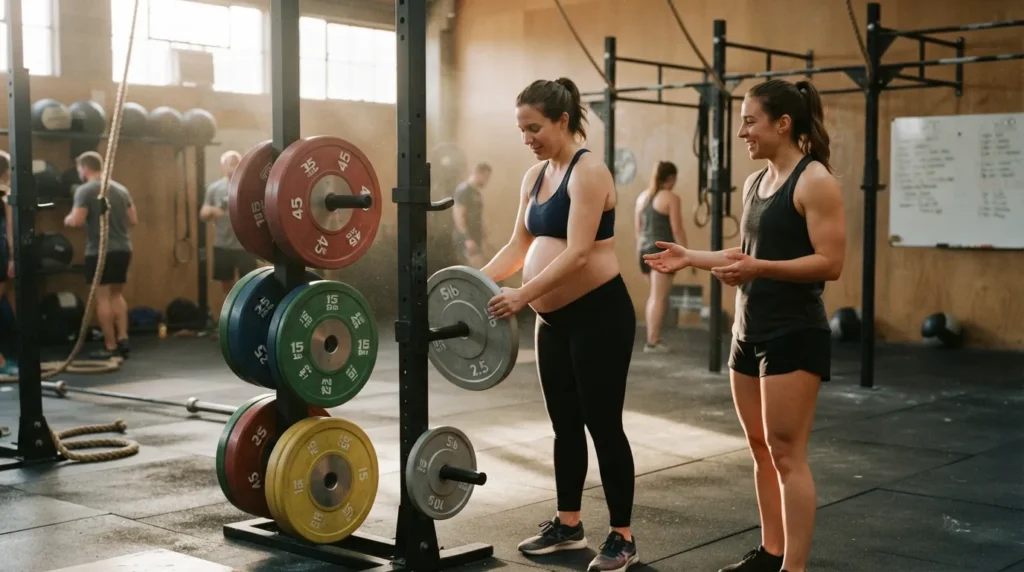
Your OB knows your medical history. Your coach knows your programming and can watch how you actually move under fatigue, which matters more than people realize. A good coach who’s worked with pregnant athletes before can help you scale on the fly, swap movements off the whiteboard without a big production, and just generally not make you feel like a liability every time you walk in.
If your gym doesn’t have anyone with that experience, it’s worth tracking down a coach or a short prenatal-specific program, even just for a handful of sessions to build out your new toolkit. I did four sessions with a prenatal coach in my second trimester and used what I learned for the rest of both pregnancies.
Where I Land on All This
CrossFit and pregnancy aren’t at odds the way people assume. Plenty of women train right up to labor, and plenty come back stronger afterward because they stayed active and stayed connected to their bodies the whole way through instead of sitting the nine months out. The version of CrossFit that works for you at 30 weeks pregnant is going to look nothing like the version that worked at 30 weeks out from a competition, and that’s not failure — that’s just what training for two actually looks like for a while.
Scale when you need to. Slow down on the hard days without guilt. And give yourself some credit for showing up at all, because that’s more than most people manage on a good day, let alone a pregnant one.