
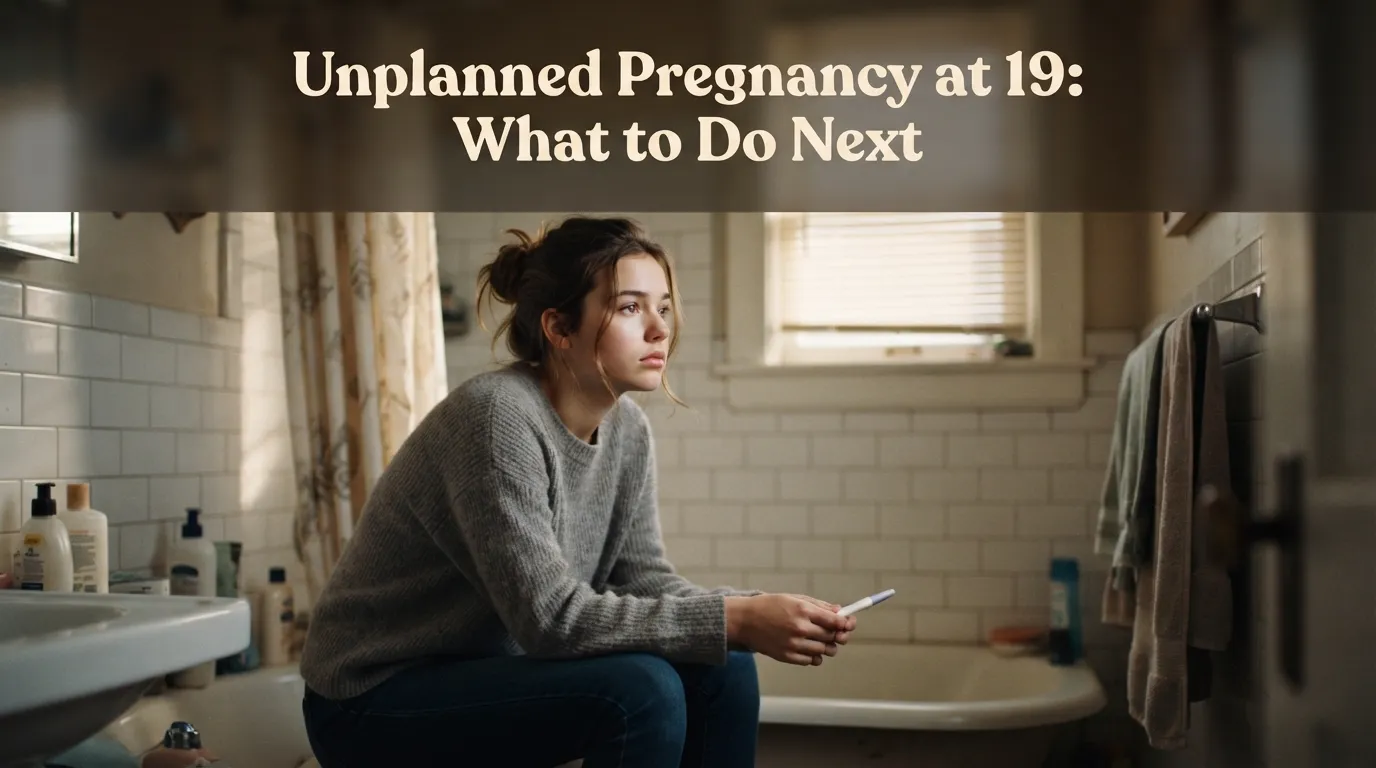
You took the test twice. Maybe three times, because the first result felt impossible. You’re sitting on the edge of a bathtub, or standing in a Target parking lot with the AC running, staring at your phone like it might change its mind. Nineteen is supposed to be about figuring out who you are — not whether you’re about to become someone’s mom.
I remember getting a call from a friend at that exact age, sitting in her dorm stairwell because it was the only place with decent cell signal and no roommate around. She wasn’t crying, exactly. She just kept saying “I don’t even know what I’m supposed to do first.” That’s really the question underneath everything else. Not “what’s the right choice” — just, what do I do in the next hour.
So here’s the next hour, and the weeks after it.
First, Give Yourself a Minute
Shock is a physical thing, not just an emotional one. Your hands might shake. You might feel weirdly calm and numb, like you’re narrating your own life instead of living it. Both are normal. Neither means you’re handling this wrong.
Try not to make any big decisions in the first day. Not because you can’t — you can — but because clear thinking needs some distance from panic first. Call in sick if you have to. Sit in your car for twenty minutes before you drive anywhere. Text your friend back later. The facts aren’t going anywhere; they’ll still be true tomorrow.
Confirm the Pregnancy Properly (Don’t Just Trust the Stick)
Home tests are accurate, but your next stop should be an actual doctor, a Planned Parenthood, or your local health department. This gets you three things at once:
- A confirmed pregnancy and a real estimate of how far along you are
- A quick check for anything medically urgent
- A person to ask questions to, instead of falling down a search-bar rabbit hole at 1 a.m.
Your exact timeline matters more than you’d think. Every option below has its own window, and some of those windows close faster than people expect.
You Actually Have Options — and No, Not Everyone Will Say This Kindly
Here’s something nobody tells you enough: you’re allowed to take your time deciding, and you’re allowed to change your mind halfway through the process. Anyone who tries to rush you toward one path — your mom, your boyfriend, your youth pastor, whoever — isn’t really helping, even if they mean well. Broadly, you’re looking at three roads.
Parenting. Plenty of 19-year-olds do raise their kids, often leaning hard on family, a partner, or community programs built for exactly this. It’s not the plan you had. It reshapes your twenties in ways you can’t fully picture yet. And still — people do it, and build good, whole lives doing it.
Adoption. This isn’t the closed-door, never-see-them-again version your grandmother might picture. A lot of adoptions today are open, meaning you can choose the family and stay in some kind of contact — letters, photos, visits, depending on what you all agree to.
Abortion. This is the one where where you live matters enormously. Gestational limits and legal access vary a lot by state and country, so if this is on your list, look into your local timeline soon rather than later.
A good pregnancy counselor can talk through all three with you honestly. Look for one connected to a hospital or a neutral reproductive health clinic — not a group that’s only going to steer you toward the option they already believe in.
Who to Tell First (and What to Actually Say)

There’s no correct order here. But a few things tend to make it easier.
Tell one person before you tell everyone. A sister, a roommate, a school counselor — someone whose reaction you can predict won’t wreck you. Say it out loud to them first. It’s a rehearsal, and it helps.
If you’re telling a parent, set the tone before you say the news. Something like, “I need to tell you something, and I need you to just listen for a second before you react” — that one line buys you a beat of quiet before the shock hits their face.
If a partner’s involved, ask straight up what you need. “I’m still figuring out what I want to do, and I need to know if you’re in this with me or not” is fair. You’re not obligated to soften it more than that.
Some parents panic first and come around later — give that a little room if you can. Some people surprise you with more steadiness than you expected. And a few just won’t handle it well, no matter how you say it. If that’s the situation you’re walking into, lean on the friends and professionals who can hold steady for you instead.
Where to Actually Find Support
You don’t have to piece this together on your own at 2 a.m. with seventeen browser tabs open.
- Planned Parenthood and local health departments offer low-cost, sometimes sliding-scale, testing and counseling — and they’ll talk through every option, not just one.
- Your school. If you’re in college, look up your Title IX office and student health services. Most have quiet resources for pregnant students that nobody advertises loudly.
- WIC (Women, Infants, and Children), if you’re in the U.S. and choosing to continue the pregnancy — nutrition support, food assistance, referrals, and it’s more accessible than people assume.
- Local pregnancy resource centers — worth knowing that a lot of these are faith-based and tend to encourage parenting or adoption over abortion. That doesn’t mean skip them; many hand out free diapers, formula, and classes. Just walk in knowing their leanings.
- A therapist, even for a few sessions. This decision carries weight that doesn’t fully clear once you’ve made your choice, and having someone neutral to talk it through with helps more than people expect going in.
If You Decide to Continue the Pregnancy
Take the logistics one at a time instead of trying to solve everything Sunday night. Check if you qualify for Medicaid or your region’s equivalent — pregnant applicants often get in regardless of income. Ask your OB about a payment plan if you’re uninsured; most offices have one, they just don’t lead with it. And don’t assume you have to drop out of school before you’ve actually asked what your options are — a surprising number of schools have quiet support systems for young parents that never make it into the orientation packet.

If You’re Leaning Toward Ending the Pregnancy
Here, timing does most of the driving. Call a clinic as soon as you can to find out what’s legally available where you are and by what week. Ask about cost up front — clinics often have funds built in, and separate abortion funds exist specifically to cover the gap, including travel if your state requires it.
If You’re Considering Adoption
Reach out to an adoption agency or attorney even before you’re sure — that first call doesn’t lock you into anything. Ask them to walk you through open versus closed arrangements. Most people are surprised by how much say they actually get in the process.
One Last, Honest Thing
Nineteen is young to be handed something this heavy, and it’s completely fair to feel furious or terrified or just not ready — sometimes all three in the same afternoon. But not being ready for this moment doesn’t mean you can’t handle it. People your age have stood right where you’re standing now and come out the other side steady again, whichever path they chose.
Give yourself the patience you’d hand a friend in this exact spot. Ask for help before you think you need it — not after you’re drowning. And know that whatever you decide, it doesn’t have to be the sentence that defines the rest of the paragraph.