
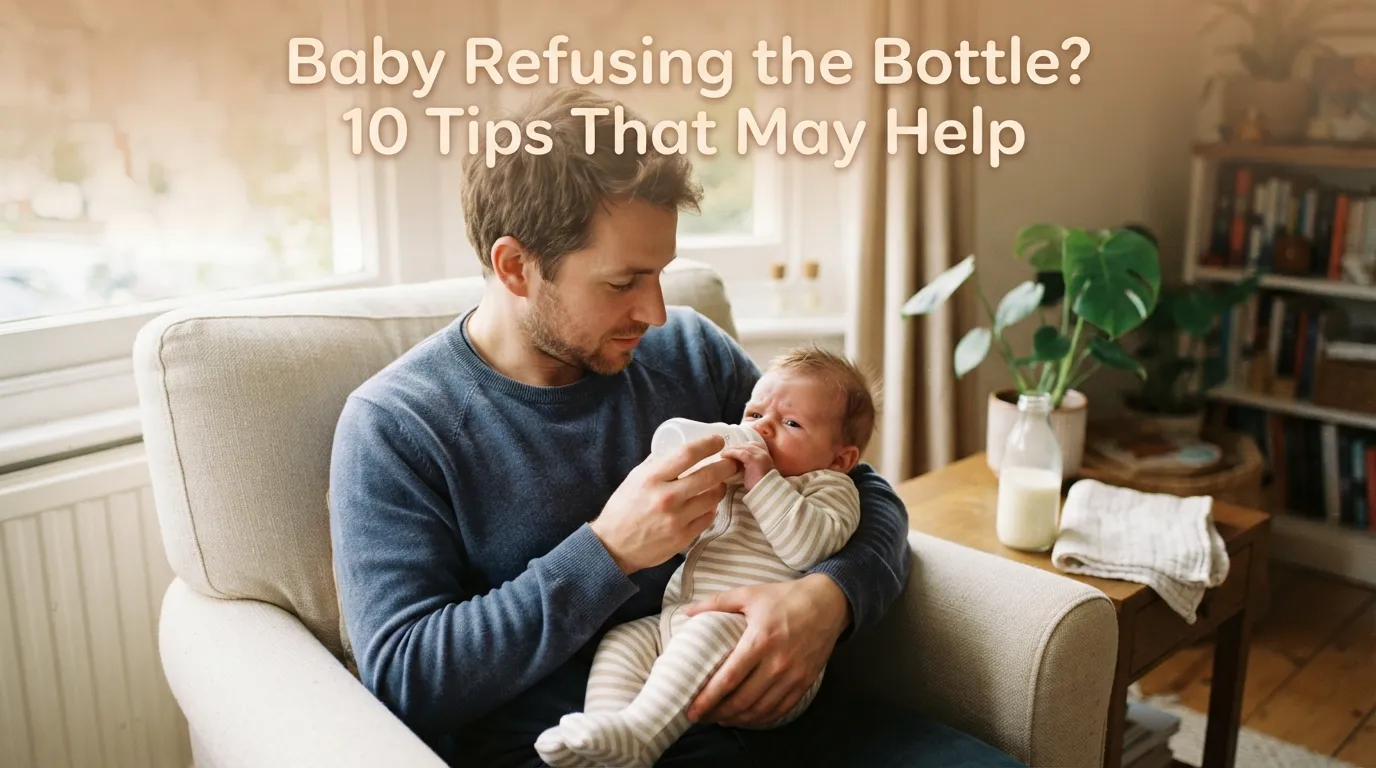
My son was seven weeks old the first time he looked at a bottle like it had personally wronged him. My mother-in-law was visiting, she’d offered to take a shift so I could shower for longer than ninety seconds, and I came downstairs to find her pacing the living room with a screaming baby and an untouched bottle of pumped milk going lukewarm on the coffee table. “He knows,” she kept saying. “He knows you’re up there.”
She wasn’t wrong, exactly. He did know. That’s sort of the whole problem, and also, weirdly, the whole solution once you understand it.
If you’re in this right now — maybe it’s a return-to-work date bearing down on you, maybe it’s just that you’d like to leave the house without a person attached to your chest for once — I want to say two things before anything else. First, this is common. Genuinely, boringly common, not a sign your baby has some rare aversion or that you’ve messed something up. Second, it usually gets better, though “usually” is doing some work in that sentence and I’m not going to pretend every baby cracks on day one.
Below is what actually moved the needle for us, plus what I’ve heard from enough other parents to trust it’s not just a fluke.
First, understand why this happens
A breastfed baby has spent every single feed attached to one very specific, very warm, very familiar source. Different smell, different texture, different rhythm, different person — a bottle isn’t a lesser version of that, it’s a completely different event as far as your baby’s concerned. So when people say “he’s just being stubborn,” I’d push back on that a little. He’s not being stubborn. He’s noticing.
Get out of the house. Not just out of the room.

I mean actually leave. If your baby can smell you or hear your voice through a wall, they know exactly where the good stuff is, and no amount of coaxing from whoever’s holding the bottle is going to compete. Go sit in your car. Go to the grocery store you don’t need anything from. Go anywhere.
We tried this properly for the first time when he was about nine weeks old — I left for a haircut I didn’t need — and my husband texted me forty minutes in to say he’d taken almost the whole bottle after about ten minutes of protest. Ten minutes felt like an eternity to him, standing there. It probably felt shorter to our son than either of us expected.
Timing matters more than people give it credit for
Don’t try this when your baby is already furious with hunger. That’s setting everyone up to fail, and worse, it teaches your baby that the bottle equals distress. A calmer window — an hour-ish after a feed, not right before the next one — tends to go better. For us that was mid-morning. For your kid it might be right after a nap, or right before the evening meltdown hour starts, or some window I can’t predict because every baby runs on their own clock.
Don’t rule out the actual bottle itself
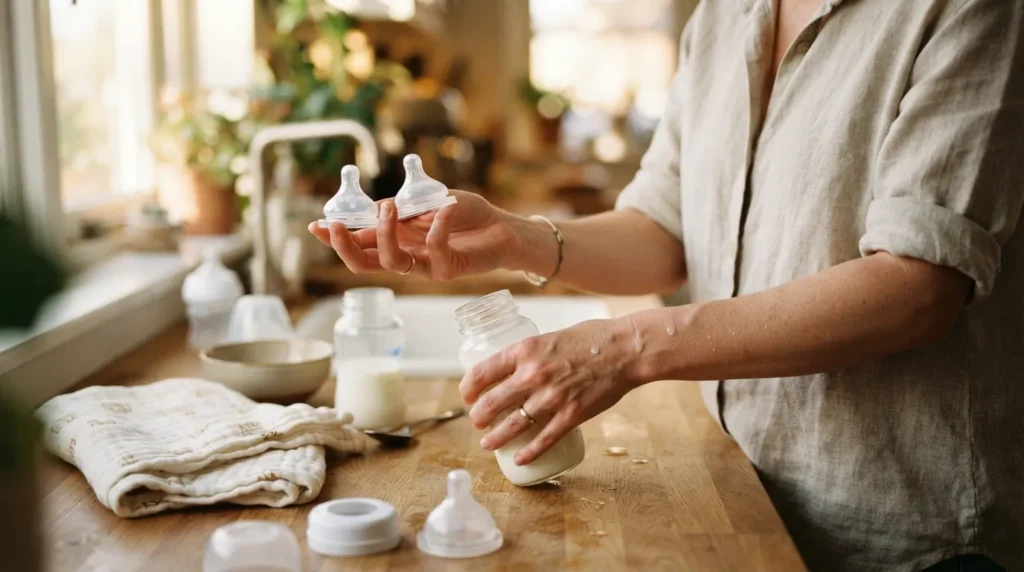
Here’s an unpopular opinion: half the “my baby won’t take a bottle” stories I hear could be solved by trying a different nipple before declaring defeat. We went through three brands. The first was a fast flow that made him choke and panic. The second was fine but he never warmed to the shape. The third — a slower, wider one — finally clicked. That’s three separate purchases and two return trips to the store, and I get why people give up before they get there, but it’s worth it if you can manage it.
Warm the milk too, obviously — body temperature, tested on your wrist. This one’s basic but it’s also the one people forget when they’re distracted and just trying to get the thing into his mouth.
Change how you’re holding him
This one surprised me. He wouldn’t take the bottle facing me in the classic cradle hold — I think because that position is nursing, as far as his brain was concerned, and getting the wrong thing in that exact posture felt like a trick. Facing him outward, or propped in a bouncy seat, or even walking laps around the kitchen while offering it, worked better. Small thing. Made a real difference.
Some parents also swear by having the bottle wrapped in something that smells like mom, or the non-nursing parent wearing one of her shirts while feeding. I was skeptical. I tried it anyway out of sheer desperation one Tuesday and honestly can’t tell you if it was the shirt or just the eleventh attempt finally paying off. Do with that what you will.
Start weeks before you need it to work, not the night before
If a bottle needs to happen eventually — daycare, a wedding, a work trip — start practicing well ahead of time. One high-pressure attempt the night before your first day back at work is a lot to put on a baby, and honestly, on yourself too. Pediatricians generally point to somewhere around four to six weeks as a reasonable window to introduce an occasional bottle, once breastfeeding is well established, though it’s worth checking with your own doctor given your specific situation.
Consider whether something else is going on
Sudden refusal — not gradual pickiness, but a hard no out of nowhere — is worth mentioning to your pediatrician, especially if it’s paired with fussiness, poor sleep, or trouble at the breast too. Ear infections, reflux, teething, growth spurts. Any of these can turn a baby who used to take a bottle fine into one who won’t. It’s not always behavioral, and it’s not always about the bottle at all.
Know when to stop and try again later
If your baby’s getting worked up — really worked up, not just mildly annoyed — stop. Comfort them. Come back to it in an hour, or tomorrow. Pushing through a full meltdown rarely ends with a baby who drinks the bottle; it usually just ends with two exhausted people. Several short, calm attempts spread across a day beat one long standoff, every time, in my experience.
If the bottle just isn’t happening, there’s a backup plan
For babies past about four months, some families skip the bottle entirely and move to an open cup or paced feeding instead. It’s not the right call for every situation and it’s worth talking through with a lactation consultant first, but it exists, and it’s good to know you’re not boxed into one method.
When to actually call someone
Most of this resolves within a week or two of low-pressure, consistent practice. If your baby’s going several days without eating enough, seems dehydrated, or you’re staring down a deadline with zero progress, don’t just white-knuckle it alone. A lactation consultant can watch an actual feeding session and often spot in five minutes what you’ve been guessing at for a week.
The part where I tell you it’ll be fine
It will, probably. Not on a schedule that’s convenient for you, and not without a few rough afternoons that make you want to throw the bottle across the kitchen. But I’ve yet to meet a baby who held out forever, and most of the parents I know who thought they had a “bottle-refusing baby” actually just had a baby who needed the right nipple, the right room, and mom out of earshot for twenty minutes. You’ll get there.