
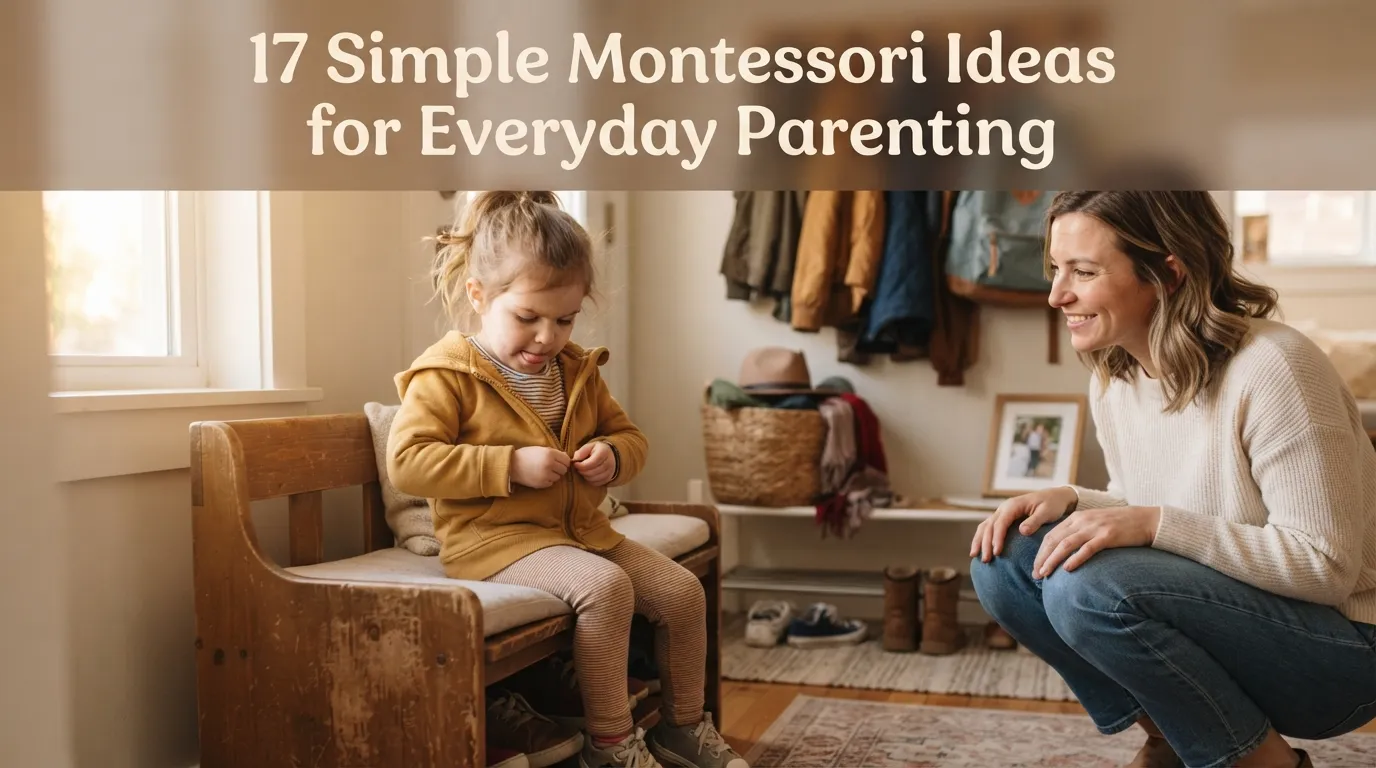
Last Tuesday my four-year-old spent eleven minutes trying to zip her own jacket. I know it was eleven minutes because I was standing there watching the clock on the microwave, willing myself not to reach over and do it for her. We were already going to be late for preschool. She got the zipper stuck twice, yanked it, groaned, started over. And when it finally clicked into place, she looked up at me like she’d just split the atom.
That’s Montessori parenting in a nutshell, honestly. Not flashy. A little slow. Occasionally maddening if you’re in a hurry. But it works, and you don’t need a $400 shelf from a Montessori supply catalog to do it. Here’s what’s actually held up in my house, through two kids, a lot of trial and error, and more spilled milk than I’d like to admit.
1. Get Stuff Off the High Shelves
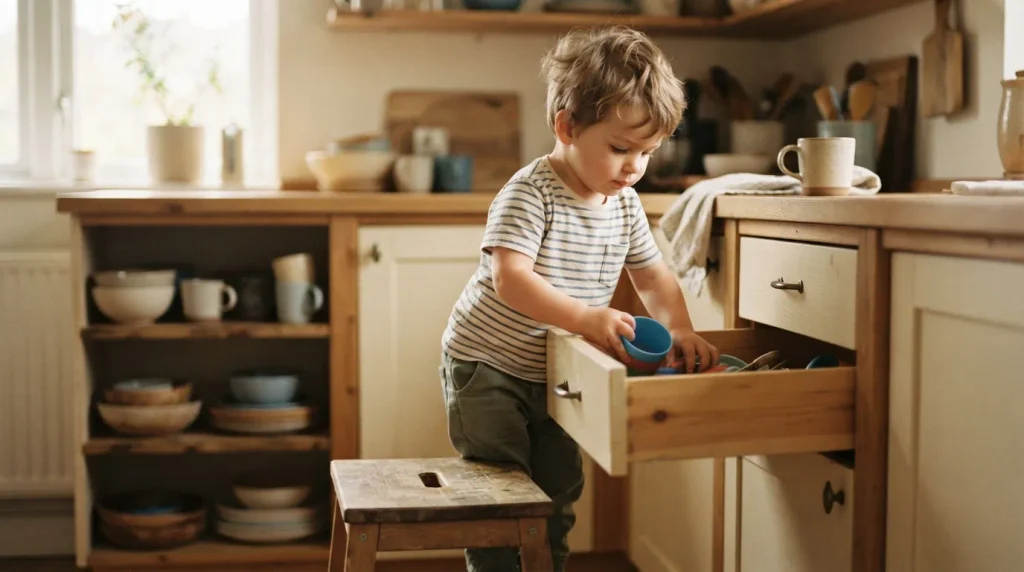
I used to keep cups in the cabinet above the fridge, which meant every glass of water was a production involving me, a step stool, and usually an interruption to whatever I was doing. Moved them to a low drawer. My son started getting his own water at three and a half. Not dramatic, but it saved me probably forty interruptions a week.
2. Skip the Toy Version, Use the Real Thing
Plastic play brooms are useless. They don’t sweep anything, and kids know it — mine tried using his for about four days before abandoning it in a corner. A small, real broom with a shortened handle actually does something, and doing something is the whole point.
3. Build In Slow Mornings, Even If It Costs You Sleep
I resisted this for a long time because I like sleep more than most people. But once I started waking my daughter up 15 minutes earlier so she could attempt her own socks and shoes, our mornings stopped being a screaming match by the front door. Worth the fifteen minutes. Barely.
4. Offer Two Choices, Never Twenty
“What do you want for breakfast” is a trap. You’ll get “candy” or “nothing” or a three-minute stare while the eggs go cold. “Do you want toast or oatmeal” actually gets an answer, because it’s a real choice a small brain can process.
A Phrase Swap Worth Stealing
Instead of “put your shoes on, we’re leaving,” try “left shoe or right shoe first?” It sounds almost too simple to matter. It matters.
5. Let the Spill Happen
My default used to be lunging for the paper towels before my kid had even fully registered the cup tipped over. Now I hand them a rag and say, “Oops, spills happen — you can wipe that up.” The first few times felt awkward. Now it’s just what we do, and my son cleans up his own messes without being asked half the time, which felt impossible two years ago.
6. Have One Room (or Corner) Where the Answer Is Always Yes
Our living room has one bottom shelf that’s entirely my daughter’s — books, a few toys, nothing breakable. She can dump the whole thing out and I don’t have to say a word. Having one zone where nothing is off-limits cuts down on the constant “no, don’t touch that” soundtrack everywhere else.
7. Fewer Toys Out, More Focus
I didn’t believe this until I tried it. Packed most of the toys into bins in the closet, left out maybe seven things on a shelf. Within a week my kids were playing longer with individual toys instead of dumping everything into one pile and wandering off. Less really is more here, annoyingly.
8. Say Less, Watch More
This one’s hard for me specifically, because I like narrating. But when my son is stacking blocks and one keeps tipping, my instinct to say “try putting the bigger one on the bottom” usually isn’t necessary. If I wait — actually wait, thirty seconds, not five — he usually figures it out and looks prouder for it.
9. Let Toddlers Do “Chores” Before They Realize They’re Chores
There’s a short window, somewhere around two to three, where kids genuinely love wiping tables and folding washcloths. It won’t last. Take advantage of it before they turn seven and suddenly every task requires a negotiation.
10. Natural Consequences, Within Reason
If it’s 60 degrees and my daughter refuses a jacket, she doesn’t need the jacket. She needs to get a little cold, then decide for herself. I keep it in the car just in case. Nobody’s ever needed an ER for being mildly chilly.
11. Drop the Baby Voice Sooner Than Feels Natural
Somewhere around age three, I noticed how differently my kids responded when I explained things instead of just commanding them. “We hold hands here because cars can’t always see short people” landed better than “hold my hand, now.” Kids can handle more reasoning than we usually give them credit for.
12. Keep the Order of the Day the Same, Even If the Clock Shifts
Our routine isn’t timed to the minute — some days breakfast is at 7, some days 8 — but the sequence never changes. Wake up, get dressed, eat, brush teeth. That predictability does more heavy lifting for behavior than almost anything else I’ve tried.
13. Count to Ten Before You Help
Genuinely — count in your head. It feels like forever. It’s not. Most of the time your kid solves the problem around second seven, right as you were about to step in and take over.
14. Hand Them a Job in the Kitchen
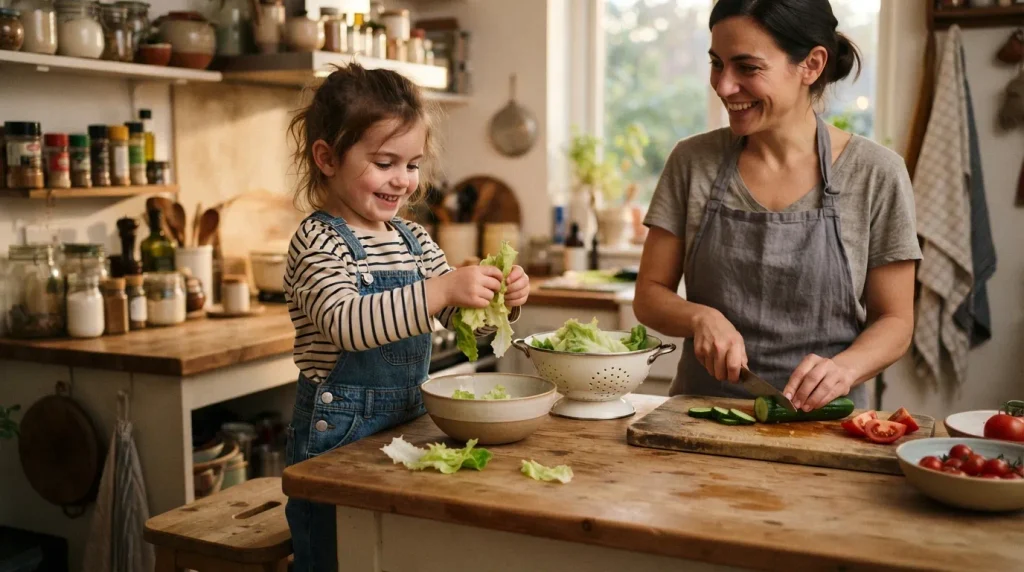
My daughter tears lettuce for salad. It’s slower than me doing it, and there’s always a stray leaf on the floor. But she eats the salad she helped make, every time, which is more than I can say for the salads I make alone.
15. Don’t Interrupt the Zone
If my son is quietly building something with intense focus, that’s not the moment to ask if he wants a snack. Concentration like that is rare and worth protecting. Save the questions for the natural break, not before it.
16. Your Calm Is the Whole Strategy
I’ve said “calm down” to a screaming toddler exactly zero times successfully. What’s worked instead is getting quiet myself, lowering my voice instead of raising it. Kids borrow our nervous system more than they listen to our words. I still forget this constantly, for the record.
17. Let Them Be Slow
This is the one I fight hardest, because I am not a naturally patient person. But every time I’ve forced my pace onto my kids’ pace, it’s ended badly. Every time I’ve built in the extra ten minutes, it’s gone fine. The math isn’t complicated. I just forget it under pressure.
The Actual Point
You don’t need all seventeen of these running at once — that’s a fast track to burning out by Thursday. Pick two. Try them for a couple of weeks. See what sticks in your particular chaos, because every kid and every house is a little different. Montessori parenting, at its core, is just trusting your kid a bit more than your instincts usually let you. Some days that trust pays off in eleven minutes with a zipper. Some days it just buys you five extra minutes of sanity. Either way, take it.