
A few years back, my daughter came home from a birthday party and mentioned, kind of offhand, that a friend’s older cousin had picked her up and spun her around even after she’d asked him to stop. She was four. Nothing bad happened — he wasn’t trying to hurt her, he was just being a rough, oblivious teenager at a bounce-house party. But it rattled me a little, because I realized in that moment that I’d never actually given her the words for “I don’t like this, stop” directed at someone she knew and liked.
That gap is the whole reason I started paying closer attention to body safety as a topic, instead of just assuming my kids would “figure it out” or that a single “stranger danger” talk in kindergarten would cover it. It doesn’t work that way. Kids need small, repeated, unglamorous conversations, threaded into ordinary days, until the ideas feel as normal as brushing their teeth.
Here’s what I’ve landed on after a lot of trial, error, and a couple of awkward conversations at the dinner table.
1. Teach the Real Names for Body Parts
I’ll admit this felt strange to me at first. My mother-in-law visibly winced the first time she heard my toddler say “vulva” like it was no different from “elbow.” But this one isn’t just about comfort with anatomy — kids who know the real words are simply harder to fool and easier to understand if something’s ever wrong.
You don’t need a whole speech. Bath time works fine: “Let’s wash your penis now, then your feet.” Same tone you’d use for anything else. No giggling, no code words, no drama.
2. Their Body Belongs to Them — Full Stop

This is the rule that causes the most friction with extended family, in my experience. Grandparents want hugs. Aunts want kisses hello. And a lot of us grew up being told to give them whether we wanted to or not.
I stopped requiring it a few years ago, and honestly, it made some holidays a little awkward at first. But my kids now know that a wave, a fist bump, or “hi, Grandpa!” from across the room is a perfectly acceptable substitute for a hug they don’t want to give. If a relative gets huffy about it, that’s a conversation for the adults to have — not a reason to override what your kid is comfortable with.
3. Good Touch, Bad Touch, and the Confusing In-Between
Most safety curriculums stop at “good touch, bad touch,” which is fine as a starting point but leaves out the touches that don’t hurt, aren’t obviously wrong, yet still feel off somehow. That gray zone is actually where a lot of real-world situations live, and it’s the hardest one for a kid to name.
I’ve told my kids something like this: “If a touch ever makes your stomach feel weird, even if you can’t say why, that counts. You don’t need a good reason to tell me. A funny feeling is reason enough.” Giving them permission to trust a vague feeling — not just an obvious violation — is, I think, the single most protective thing on this whole list.
4. No Secrets About Bodies, Only Surprises
“This is our little secret” is such a classic manipulation line that it’s almost a cliché — and yet it works, over and over, because kids are wired to want to keep promises to adults they trust.
So I draw a hard line between secrets and surprises in our house. A surprise gets revealed eventually and makes people happy — a hidden birthday cake, a surprise trip. A secret that involves anyone’s body, and that comes with instructions never to tell? That one gets broken immediately, no matter who asked for it or what they promised in return.
5. A Short List of Actual Safe Adults
“Tell a trusted adult” sounds nice on a poster but means almost nothing to an eight-year-old in a scary moment. Sit down and name real people. In our case it’s me, my husband, my sister, and my son’s teacher — four names, memorized, revisited every school year.
Ask your child to repeat the list back occasionally, and update it as their world changes. A kid who’s scared or confused is far more likely to act on “go find Ms. Patel” than on some abstract idea of a trustworthy grown-up.
6. Saying No to a Grown-Up Is Allowed
Here’s an uncomfortable truth: we spend years training kids to be polite, obedient, and non-disruptive around adults, and then we’re somehow surprised when they can’t say no to one who crosses a line. Those two things are in direct conflict, and I think a lot of parents don’t clock that until it’s pointed out.
We actually practice this out loud sometimes, almost like a game. “What do you say if someone — even a grown-up you know — tries to touch you somewhere private?” My son yells “NO!” like he’s auditioning for a play, and honestly, I want that reaction baked in so deep it’s automatic.
7. Privacy Rules That Apply to Everyone in the House
Closed doors while dressing. Knocking before entering a sibling’s room. No barging into the bathroom because you’re “just grabbing a towel.” These rules matter less for any single incident and more because they set a baseline — so a violation of privacy reads as unusual rather than normal.
By four or five, most kids can handle bathing and using the toilet with the door shut, and I’d encourage letting them, even if it means you’re standing outside asking “are you okay in there?” every ninety seconds for a while.
8. Screens Come With Their Own Body Safety Rules Now
This one didn’t exist when I was a kid, and it genuinely worries me more than the in-person stuff some days. Even a seven-year-old with occasional access to a tablet or a friend’s phone needs to know that nobody — not a stranger, not an online “friend,” not someone posing as a kid their own age — should ever ask to see a photo of their body, or show them one.
The script I use is simple: “If anyone online ever asks for a picture like that, or shows you one, come tell me right away. You will not lose your device, and you will not be in trouble.” That last part matters more than people think. A lot of kids stay quiet purely because they’re scared of losing screen time, not because they’re scared of the person who asked.
9. Watch for the Tricks, Not Just the Threat
Kids can spot a stranger with candy from a mile away — that lesson landed decades ago. What they usually can’t spot is a familiar adult using flattery, guilt, or bribery to get them to keep something quiet. “You’re my favorite.” “Don’t tell your mom, she’ll just get upset.” “I’ll get you that toy if this stays between us.”
Name these patterns directly, without needing to get graphic about it. “Sometimes people use gifts or secrets to try to get kids to go along with something. If a gift comes with ‘don’t tell,’ that’s a trick — and it’s always okay to tell me anyway.”
10. Telling You Is Never Tattling — And You Will Believe Them
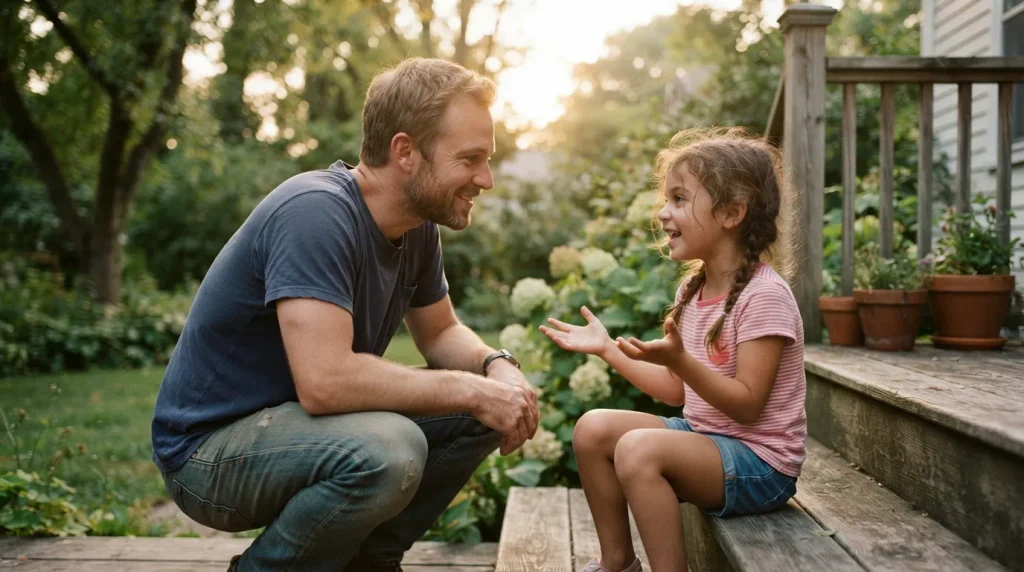
Save this one for last because, honestly, it’s the one that determines whether all the others actually work. If a kid doesn’t trust that coming to you will go well, none of the vocabulary or scripts matter.
This isn’t really something you teach with a script at all — it’s something you prove through how you react to small stuff. When my daughter told me she’d accidentally broken a lamp and immediately braced for me to yell, and I didn’t, that mattered more than any lecture I could have given about honesty. The way you handle the small confessions is basically a dress rehearsal for whether you’ll hear about the big ones.
Where This Actually Fits Into Your Week
You don’t need a calendar reminder for “Body Safety Talk.” Most of this slots into moments you’re already having:
- Bath time is a natural spot for anatomy names and privacy rules.
- Greetings and goodbyes at family gatherings are the moment to reinforce bodily autonomy — in the moment, not after the fact.
- Bedtime tends to be when kids get more talkative about the harder stuff, so leave room for it instead of rushing straight to lights-out.
- Circle back every few months. Kids forget, and their understanding deepens with age, so this isn’t a one-and-done conversation no matter how good the first one was.
Frequently Asked Questions
How young is too young to start? Younger than most people assume. Around two or three, once a child is verbal, you can start with the basics — real body part names, “your body is yours,” and simple okay-touch-versus-not-okay-touch language. You’re not explaining abuse at that age. You’re just laying groundwork the rest builds on later.
My kid didn’t tell me something until months after it happened. Did I fail somewhere? No. This happens all the time, and it usually says nothing about how well you covered this material. Kids often need a trigger — a school lesson, a book, a random conversation — before the words come out. If it happens to you, the only thing that matters is your reaction in that moment: calm, believing, no panic. Panic afterward can make a kid regret telling you at all, which is the opposite of what you want.
How do I bring this up without making my kid anxious about the world? Keep the tone as boring as possible, honestly. Say it the way you’d remind them to look both ways crossing the street — matter-of-fact, not urgent. Kids pick up on your emotional register more than your actual words, so if you stay calm, they’ll file this information away calmly too.
Isn’t this more about strangers than people we know? Actually, it’s the opposite — most situations involve someone the child already knows, which is exactly why rules like bodily autonomy and no-secrets apply just as much to family and family friends as to anyone else. That’s an uncomfortable thing to sit with, but it’s the more useful place to focus your energy.
What do I actually do if my child tells me something concerning? Stay calm on the outside even if you’re not calm on the inside. Let them talk without jumping in with leading questions. Say thank you, say you believe them, and don’t confront anyone in the heat of the moment. Depending on what you hear, your next call might be your pediatrician, a school counselor, or, if it warrants it, local authorities.
How often should we revisit this? Think ongoing, not one-time. Check back in every few months for younger kids, and expect the conversation to shift as they get older — sleepovers, new devices, more independence all call for an update to the rules you set when they were five.
One Last Thing
None of this is about scaring your kids or making them see danger around every corner. It’s about handing them language, permission, and enough self-trust that if something ever does feel wrong, they’ve already got the words ready — and they know exactly whose door to knock on. That’s really the whole point. Not a flawless safety lecture, just a kid who trusts their gut and trusts you enough to open their mouth.
Meta description: Ten practical body safety rules every parent should teach their kids, with real scripts and age-appropriate tips for everyday conversations.