

Real, realistic baby activities for 0–3 months from a parent who’s been there — no gimmicks, just simple ways to bond and support development.
My son was nine days old the first time I tried to “play” with him. I’d read somewhere that tummy time was important, so I laid him on a blanket in the living room, sat cross-legged in front of him like we were about to have a business meeting, and waited. He lasted maybe forty seconds before his face crumpled and he let out this outraged little squawk, like I’d personally offended him. I remember thinking, well, that went badly. I’m apparently already failing at this.
I wasn’t failing. I just didn’t understand yet what “playing” with a newborn actually looks like, because it’s nothing like what the word suggests. There are no toys involved, most of the time. There’s no game with rules. It’s you, your face, maybe ten minutes, and a baby who is quietly cataloguing the entire world for the first time.
By the time my daughter came along two years later, I’d relaxed a lot about all this. I stopped trying to fill her awake time with activities and just… paid attention to her. Turns out that’s basically the whole trick. Below are 25 things that actually worked in our house — some are classics, a few I stumbled into by accident, and one or two I’m slightly embarrassed to admit I did.
First, a Reality Check on What “Playing” Even Means Right Now
Newborns are awake for shockingly little time. In the first few weeks, you might get 30 to 45 minutes of true alert wakefulness between naps, and that includes feeding and diaper changes eating into it. So if you’re picturing a dedicated “playtime” the way you would with a toddler, let that go. It’s not going to happen, and you’re not behind.
What actually happens is smaller and more scattered than that. A minute of eye contact while you’re burping them. Thirty seconds of a silly face during a diaper change. It adds up, even though it doesn’t look like much while you’re in it. Most newborn activities at home succeed or fail based on timing, not creativity — catch your baby in that calm, alert window (usually right after a feed, not right before) and almost anything works. Try the same thing when they’re overtired and it’ll flop.
Face-to-Face Play: Where the Real Magic Happens
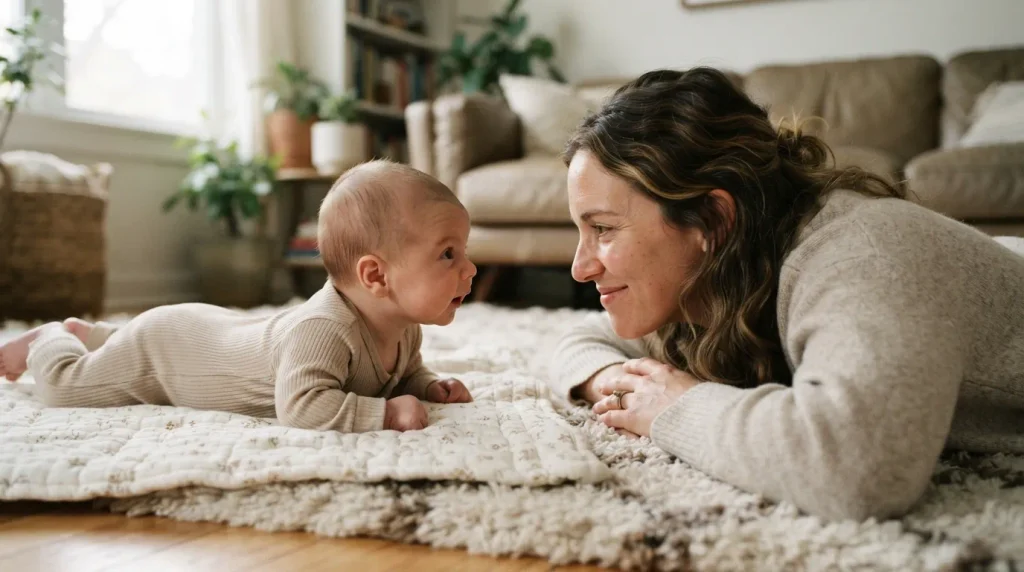
1. Get close and just talk to them like a person. Not baby talk necessarily — just talk. “Okay, we’re going to change your diaper now, and I know you hate this part, I’m sorry.” Newborns see best at 8 to 12 inches, which is roughly the distance from your face to theirs when you’re holding them. That’s not a coincidence.
2. Try the tongue-out thing. Some newborns will actually mimic this — stick your tongue out slowly, hold it a few seconds, and watch. It didn’t work with my son until about three weeks. It worked with my daughter on day four, which made me feel like she was already smarter, which is obviously not how babies work, but try telling a sleep-deprived parent that.
3. Overact your facial expressions. Big eyebrows. Exaggerated shock. A slow, dramatic smile. You will feel like a cartoon character. That’s the point — subtlety is wasted on a two-week-old.
4. Sing something, anything, badly. I sang the same three Fleetwood Mac songs to both my kids for months because that’s what was in my head. Neither of them cared that I can’t hold a tune. They cared that I was close and making sound.
5. Narrate the boring stuff out loud. “Now your arm goes in here, now the other one, ugh, why do onesies have so many snaps.” It sounds pointless. It’s not — it’s the earliest version of teaching them language, and it fills the dead air of routine care.
Movement, Touch, and Building Body Awareness
6. Do tummy time in short, frequent bursts — not one long session. A minute or two, several times a day, is more realistic and more effective than trying to force ten straight minutes. My son genuinely hated it until about six weeks in, then suddenly tolerated it fine. That’s normal. Don’t read into early resistance too much.
7. Bicycle their legs gently. Lying on their back, slowly pedal their legs like they’re riding a tiny invisible bike. Good for gas, good for a bit of one-on-one touch, and it’s one of the few things that reliably calmed my daughter during evening fussiness.
8. Offer a finger for them to grip. The grasp reflex is strong these first weeks — let them squeeze your finger and just sit with that a second. It’s a small thing. It still gets me every time.
9. Gently open and cross their arms. Like a slow-motion jumping jack. My son loved this. My daughter tolerated it for about four repetitions before she was clearly done, and she let me know.
10. Support them “standing” on your lap. Hold them upright under the arms, feet touching your thighs. Newborns often push down reflexively — it’s not real standing, but a lot of babies seem to like the sensation of weight on their feet.
Sensory Play That Doesn’t Require Any Special Toys
11. Show them high-contrast images. Black-and-white patterns or bold red shapes are easiest for young eyes to track. A basic set of flashcards works, or honestly, a striped kitchen towel held up at the right distance does the job too.
12. Let different textures touch their skin. A fuzzy blanket, a slightly rough towel, your own hand. Do this during a diaper change and it costs you zero extra minutes.
13. Let them just hear your house. The dishwasher humming. Rain on a window. You don’t need white noise apps or curated sound machines — the actual ambient noise of your home is plenty stimulating.
14. Prop up an unbreakable baby mirror. They have no idea it’s them. Doesn’t matter. The movement and contrast hold their attention, especially during tummy time when they need a reason to lift their head.
15. Let them smell things. A clean washcloth, your neck after a shower, a flower held a safe distance away. Smell is sharper than you’d think at this age, and it’s an easy one to fold into a normal day.
Working Play Into Routines You’re Already Doing
16. Make diaper changes a two-way conversation, even though it’s one-way. This is dead time otherwise, and there are a lot of diaper changes in a day. Use a few of them for eye contact and talking instead of just getting through it.
17. Sway slowly to music while holding them. You don’t need rhythm. You need arms and a body that moves. This one doubled as a wind-down tool at our house more than a “play” activity, if I’m honest.
18. Read out loud, even though they can’t follow a word of it. I read my daughter the backs of cereal boxes some mornings because that’s what was in front of me. What she’s absorbing isn’t the story — it’s the rise and fall of your voice.
19. Make eye contact during feeds instead of scrolling your phone. I’ll be honest, I didn’t always manage this one. Feeding sessions in the newborn haze are often the only quiet minute you get, and sometimes you need that minute for yourself, not for bonding. But when I did put the phone down, it made a noticeable difference in how connected those feeds felt.
20. Let warm water trickle over their belly at bath time. Once your pediatrician gives the go-ahead for baths, this tends to be calming rather than stimulating. Neither of my kids treated bath time as “play” exactly — it was more like a tiny spa moment they tolerated.
A Few Simple Tools Worth Having Around
21. A basic play gym with hanging toys. Even before they can bat at anything on purpose, lying underneath and looking up at slow-moving shapes gives them something to focus on.
22. A soft rattle, shaken a little to the side. Somewhere around six to eight weeks, babies start turning their heads toward sound. It’s a small milestone that feels disproportionately exciting the first time you see it happen.
23. A black-and-white mobile over the crib. Less a toy for active play, more a calm visual anchor during those drowsy, half-asleep stretches.
24. Crinkly fabric books. The sound and texture matter more than any actual “story” right now. My daughter was more interested in chewing on the corner of one than looking at the pages, which, fine, also counts as engagement.
25. A few minutes outside, even just on the porch. You don’t need a full stroller walk. Fresh air, dappled light, the sound of wind — five minutes counts, and some days five minutes is genuinely all you’ll have in you too.
A Few Honest Notes on Pacing Yourself
You will not do all 25 of these in a day, and you shouldn’t try. Pick two or three that suit your baby’s personality and your own energy level that particular day, and let the rest go.
Watch for the early tired signs — yawning, looking away, a fussiness that’s just starting to build — and stop before it tips over, not after. Newborns hit overstimulation fast, and pushing through a fussy moment to “finish” an activity tends to backfire on everyone involved.
And on the days where all you manage is holding your baby and staring at each other for ten quiet minutes before the next feed? That’s not a lesser version of anything. Some days, that actually was the whole activity, and it was enough.
Frequently Asked Questions
How much should I actually be “playing” with my newborn each day? There’s no real number to hit. It’s less a scheduled session and more scattered minutes throughout the day, caught during those short alert windows. Ten genuine minutes of face-to-face time beats an hour attempted on an overtired baby.
What if my baby just stares blankly and doesn’t seem interested in anything I try? Completely normal, and it happened constantly with both of mine. At this age, interest can look like almost nothing outwardly — a slight shift in gaze, a change in breathing. Don’t read a blank stare as a sign you’re doing something wrong.
How do I tell overstimulation apart from just being tired? Look for the head turning away, an arched back, fingers splayed out, or fussiness that keeps climbing instead of settling once you pause. When you see that, stop the activity rather than pushing through — dim the room, hold them close, let it settle.
Is any amount of screen time okay in these early months? Most pediatric guidance suggests avoiding screens entirely under 18 to 24 months. It’s not that a stray few minutes will do damage — it’s that a newborn gets essentially nothing developmental out of it, and that time is better spent on face-to-face interaction, which they do actually benefit from.
When should tummy time start, and how much is enough? You can start on day one, a minute or two at a time, several times daily, always supervised. By around three months, many babies can handle 10 to 15 total minutes spread across the day. Early resistance is common — short and frequent beats one long forced attempt.
Do I actually need to spend money on newborn toys? Not much, honestly. A play gym and a couple of high-contrast cards go a long way, and your own face and voice do more heavy lifting than anything you’ll buy. Save the bigger toy budget for around four to six months, once they start reaching and grabbing on purpose.
How do I fit any of this in when I’m running on no sleep? You mostly don’t add it on top — you fold it into what’s already happening. Talk during diaper changes, hold eye contact during a feed, hum while you sway them to sleep. Skipping a dedicated “activity time” doesn’t mean you’re failing; for a baby this age, the ordinary moments of your day already are the activity.
One Last Thing
Nobody remembers, months later, which specific activity they did on which day. What sticks is a general sense of having been paid attention to — of a parent’s face showing up again and again, close and unhurried. That’s really the whole assignment for these first three months, even on the days it doesn’t feel like much.