
My daughter was eight when we told her, and she asked, completely deadpan, whether she’d still get to bring her stuffed rabbit to both houses. Not “will you still love each other,” not “why is this happening” — the rabbit. That was the thing her whole eight-year-old brain latched onto.
I bring this up because I’d spent two days prepping for tears, for hard questions, for some kind of scene. What I got instead was a logistics interview about a stuffed animal. And that’s the first thing I wish someone had told me: you can’t script this. You can prepare, and you should, but your kid is going to react like your kid, not like the kid in the parenting article.
So here’s what I’ve learned — some from doing this myself, some from watching friends do it worse or better than I did, and a little from a family therapist we saw for a few months afterward who was blunt in a way I appreciated.
Do It Together If You Can Stand To
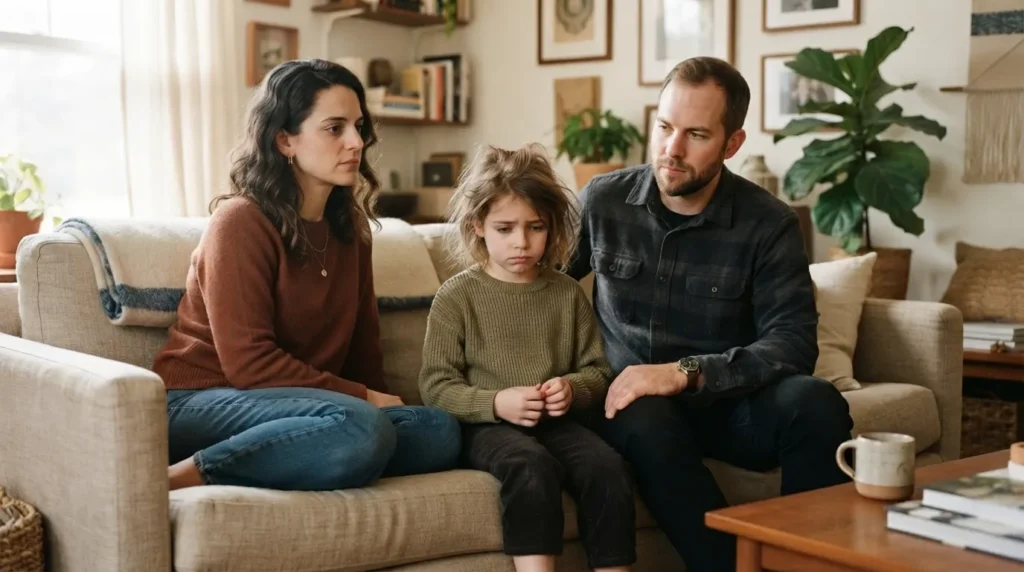
I know. I know how that sounds when you can barely be in the same kitchen as your ex right now. But if there’s any way to sit down as two parents and deliver this news as a unit, do it. It matters more than almost anything else on this list.
My ex and I sat on opposite ends of the couch, which in hindsight is a little symbolic, but we said the same things, in the same tone, and our daughter could see we weren’t at war in that particular moment. Kids pick up on mismatched energy instantly — if one of you is stone-faced and the other’s fighting back tears, that discrepancy becomes the story, not the divorce itself.
If it’s genuinely not safe or possible to do this together — and sometimes it isn’t, and that’s a real thing, not a failure — at least try to agree beforehand on what gets said, so your kid isn’t getting two different versions from two different rooms.
Timing Matters More Than You’d Think
Don’t do this on a Tuesday morning with backpacks half-zipped by the door. Don’t do it the night before a big test, or two days before their birthday party, or over Thanksgiving weekend because “everyone’s already together anyway.” I’ve heard that last one from more than one friend, and every single time, it backfired.
Friday evening worked for us. It gave the whole weekend as a buffer — time for her to be upset, ask questions on Saturday she hadn’t thought of Friday night, or just go be a kid at the park and not think about it for a few hours. Whatever you pick, give it room to breathe afterward instead of rushing back into a normal schedule five minutes later.
Phones away. TV off. This is not a conversation to half-have.
Keep It Simple — Genuinely Simple
Here’s an opinion I’ll stand behind: your kid does not need to know why. Not the real why, anyway. Not the affair, not the money fights, not the fifteen years of slow-burn resentment. That’s yours to carry, or to unpack with a therapist, or to vent to your sister about at 11 p.m. It is not your seven-year-old’s information to hold.
For a younger kid, something like this does the job:
“Mom and Dad have decided we’re not going to be married anymore. That doesn’t mean we stop loving you — that will never, ever change. You’re going to have two homes now, and we’ll both still be right here taking care of you.”
With an older kid or a preteen, you can give a little more shape to it without opening the whole file:
“We’ve grown apart, and we’re not able to make each other happy as a married couple anymore. This isn’t about anything you did — it’s a decision the two of us made, and we both love you exactly the same as always.”
Teenagers are a different animal. Mine wasn’t a teenager yet when we went through this, but I’ve talked to enough friends with older kids to know — teens can smell a dodge from across the room. You still don’t have to hand them the whole story, but something closer to “We tried to work through our problems for a long time, and we’ve realized we’re better as co-parents than as a married couple” tends to land better than a sanitized version they can see right through.
Say the Quiet Part Out Loud: “This Isn’t Your Fault”
Almost every kid — I mean almost every single one — is quietly wondering if they caused this. Even the confident ones. Even the ones who seem totally fine. Say it before they have to ask, because a lot of them won’t ask. They’ll just carry it.
“This is not your fault. Nothing you said, nothing you did — none of it caused this, and none of it could have stopped it.”
Then say it again in a week. And probably again a month from now, in some offhand way, because kids — especially younger ones — have a way of looping back to “was it me” even after they’ve nodded and said they understood the first time.
Let Them React However They React
Some kids sob. Some go completely silent and ask if they can go back to their Legos. Both are fine. I’ve talked to parents who panicked because their kid seemed “too okay” with it, and then three weeks later the school calls about a meltdown over something totally unrelated — that’s often the divorce showing up sideways.
Don’t chase the silence with reassurance you’re not sure they need yet. If your kid doesn’t want to talk in that first conversation, let it sit. Just make sure the door’s clearly open:
“You don’t have to talk about it right now if you don’t want to. But whenever you’re ready — mad, sad, confused, whatever it is — I want you to come find me.”
Give Them Real Answers About the Boring Stuff
Once the shock wears off a little, kids get practical fast. Where do I sleep? Do I switch schools? What happens to the dog? These sound small to us. They are not small to a kid whose entire sense of stability just got a shake.
Have actual answers ready, not placeholders. “We’ll figure it out” is technically true and completely unsatisfying to hear when you’re nine. Even a partial, honest answer — “You’ll stay at your same school, weekdays here, weekends at Dad’s new apartment” — gives them something solid to stand on while the rest gets sorted out.
Don’t Make Them Your Messenger
This is the one I’ll get a little preachy about, because I’ve watched it damage kids more than almost anything else on this list. Don’t ask your child to pass messages to your ex. Don’t ask “how was it at your dad’s” in that particular tone that’s really fishing for intel. Don’t let your co-parent’s name come out of your mouth with an eye-roll attached, even on the days they’ve earned it.
Your kid loves both of you, messy as that love might feel to you right now. Every time they get put in the position of picking a side, or reporting back, or managing your feelings about your ex — that’s a small crack in their sense of safety. It adds up faster than you’d expect.
This Isn’t a One-Time Conversation
The talk you have on day one is not the only talk you’ll have. My daughter brought it up again out of nowhere three months later, in the car, right after I’d asked what she wanted for dinner. No warm-up, no lead-in — just “do you still love Dad even though you’re not married.” Kids do that. They process on their own timeline, not yours.
Check in every so often, low-key, no pressure:
“How are you feeling about everything with our family lately? Anything on your mind?”
Sometimes you’ll get a shrug. Ask anyway. The asking matters even when the answer doesn’t come.

There’s no version of this where your kid feels absolutely nothing — divorce reshapes their world, and pretending it doesn’t is its own kind of dishonesty. But kids hold up better than we give them credit for, as long as they feel loved and told the truth, even the simplified version of it.
You don’t need to get every sentence right. My daughter still remembers the rabbit question more than anything I said that night. You just need to keep showing up, keep answering honestly, and keep reminding them — over and over, for as long as it takes — that you’re still their parent, no matter what shape the family takes now.