

My son used to do this thing where he’d get home, see his backpack sitting by the door, and just… walk past it. Like it was a chore he’d assigned to a ghost. For a solid stretch last spring, 6 p.m. was basically a coin flip: either we got through spelling words without incident, or someone (usually me, if I’m honest) ended up raising their voice over a math worksheet with eleven questions on it.
Eleven questions. I used to sit there thinking, this is not a big ask, why is this the hill we’re dying on tonight.
If you’re deep in that same nightly standoff, here’s the thing I wish someone had told me sooner: it is almost never about the homework. The worksheet is just the thing that’s visible. What’s actually going on is usually buried a layer or two down, and once you dig for it, the fighting tends to lose a lot of its charge.
I’m not going to pretend I have this fully solved — some nights still go sideways at my house. But here’s what’s actually moved the needle, for real kids, in a real house, not in theory.
It’s Rarely “Laziness.” Dig One Layer Deeper.
I hate the word lazy when it comes to kids. I said it about my own son once, in a moment I’m not proud of, and afterward I felt like I’d missed something important about him.
Turns out what looked like laziness was actually him not understanding fractions and being too embarrassed to say so out loud. “I hate homework” was doing a lot of translation work for “I don’t get this and I don’t want you to know that.”
That’s one version. I’ve also watched it go the opposite way with my daughter — she’ll refuse to do the exact same page of reading comprehension questions three weeks in a row, and it turns out she finds them insultingly easy and would rather read an actual book, thank you very much. Two kids, two completely different homework fights, same house, same rules. Nobody warns you about that part.
A few other things I’ve learned to check for before assuming it’s defiance:
Is she starving? A kid who hasn’t eaten since lunch at 11:40 is not going to have the bandwidth for long division, and no amount of firm parenting voice is going to fix low blood sugar.
Is he wiped out? Six hours of sitting still and following instructions is genuinely tiring for a seven-year-old, even though it doesn’t look like much from the outside.
Did we skip the buffer? If we go straight from the car to the kitchen table with zero decompression time, it’s basically guaranteed to blow up. I learned this one the hard way, more than once.
The Routine Fix Nobody Wants to Hear (Because It’s Boring)
Here’s the unglamorous truth: a lot of the nightly refusal calms down once homework stops being a surprise every single day. Kids who fight everything tend to do better, weirdly, with less to fight about — and a predictable routine removes one more decision point from an already tense hour.
We built ours on a Sunday, at the kitchen table, when nobody was mad at anybody. It’s not fancy. Snack and twenty minutes of nothing right after school. Homework starts at 4:30, same spot every day — same chair, same weird corner of the table my son insists on. And we stop at 5:15, finished or not, and I email the teacher if it’s not.
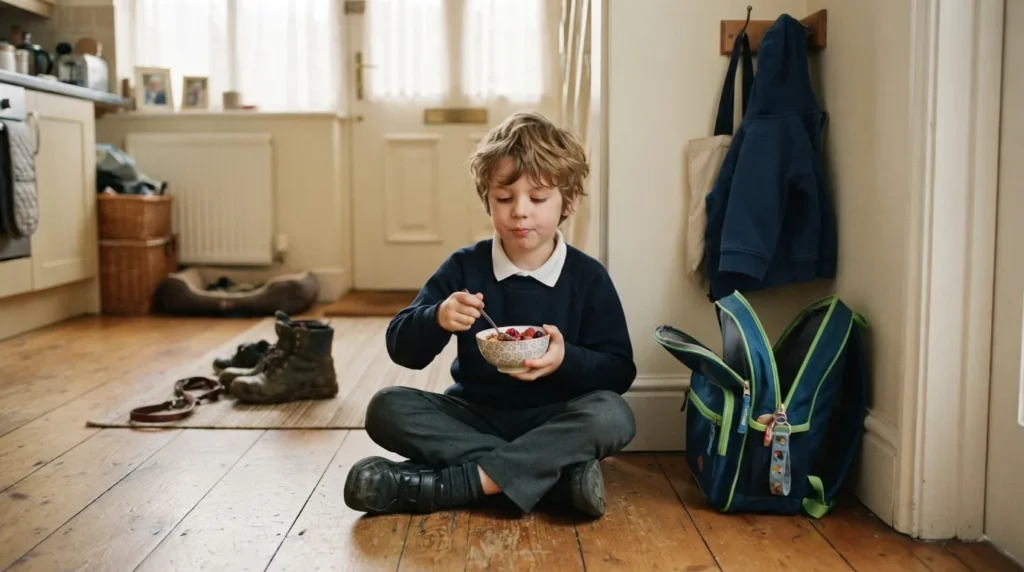
That last piece changed more than I expected. Once my son realized homework had an actual edge to it — a real stopping point, not an invisible finish line that kept moving — some of the dread went away. It stopped being a bottomless pit and started being just… a thing that happens for 45 minutes.
Give Them a Little Steering Wheel
Something clicked for me when another mom put it this way: your kid spends six hours a day being told exactly what to do, when, and how. Homework is often the first thing after the school bell where they get any say at all. Of course some of them push back there. It’s basically the only lever they’ve got.
So I started handing over small, real choices. Not fake ones — “do you want to start now or in five minutes” is not a real choice, and kids know it. I mean things like which subject first, math or spelling. Table or the floor with a clipboard. Me sitting right there, or checking in every ten minutes while he works solo.
None of that costs me anything as the parent. I still decide that homework happens. He just gets to decide some of the how, and that alone has defused more fights than any sticker chart we ever tried.
Watch What You’re Modeling, Even by Accident
This one embarrassed me a little. I noticed I was sighing — actually sighing, out loud — every time I said “okay, homework time.” My son picked up on that faster than I picked up on doing it. Kids read tone way before they read words.
So I made myself say “let’s knock this out” instead of the sigh-and-announce combo. Sounds small. It’s not nothing, though — over a few weeks it genuinely shifted the mood in the room before we’d even opened a folder.
What I Actually Say When He’s Already Refusing
Because sometimes prevention doesn’t matter — he’s already sitting there, arms crossed, jaw set, saying “I’m not doing it.” In that moment, here’s what tends to actually work, versus what just makes it worse.
What works: “I hear you. It still has to happen. What would make it easier right now?” That validates the feeling without caving on the expectation, which matters more than it sounds like it should.
Also works, oddly: “You don’t have to want to do this. You just have to start.” Taking the enthusiasm requirement off the table removes a weird pressure point.
And honestly, the timer trick still bails me out more than I’d like to admit. “Ten minutes. Let’s just see how far we get.” Ten minutes feels survivable to a kid in a way “finish your homework” never will.
What doesn’t work, in my experience: threatening tomorrow, comparing him to his sister (never, ever do this, it backfires instantly), or launching into a responsibility lecture mid-meltdown. Save that conversation for later, when everyone’s regulated again. Nobody absorbs a life lesson while they’re crying about long division.
When It’s Worth Emailing the Teacher
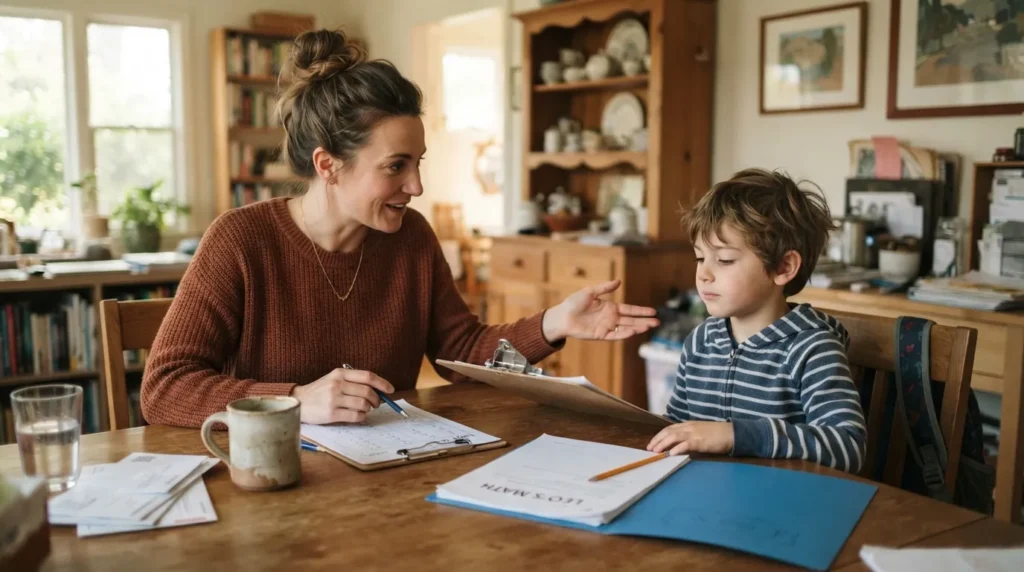
If this has been going on for weeks and not just a rough patch, email the teacher. Keep it simple: “Homework has become a real struggle most nights at home. Can you help me figure out if the workload’s off, or if there’s a specific concept she’s stuck on?”
I did this last fall and found out my son’s teacher had genuinely no idea homework had become a nightly battle, because he was a completely different kid at school — engaged, participating, no issues. That’s actually really common, by the way, and it’s not a red flag. It usually just means he’s holding it together all day and unloading the second he feels safe, which is you.
The Thing I Had to Let Go Of
I used to think finishing homework, every night, fully and neatly, was part of being a good parent. I’ve mostly let that go. Some nights three problems done with real effort beat ten done through tears just to check a box on my end.
I’d rather my kid still like reading in five years than have a flawless homework record right now. That’s just where I’ve landed, and I know not everyone agrees with me on that, and that’s fine.
Where This Actually Leaves You
It gets better, but not in a straight line — expect some weeks to still be a mess, because that’s just how it goes. What actually shifts things is the routine getting predictable, your kid getting a real say in some small piece of it, and homework quietly stopping being the nightly hill everyone dies on.
Some nights it’s still eleven questions and a fight. Most nights, now, it’s not. I’ll take that.