

20 real, practical self-esteem activities for teen girls that build genuine confidence — no vague platitudes, just things that actually work.
My daughter came home from ninth grade last spring, dropped her backpack in the hallway like it weighed two hundred pounds, and said, “I hate how I look in every single photo from today.” There were, I later found out, exactly four photos. She wasn’t fishing for compliments — she’d already deleted them off her phone before I could even look. I remember standing there with a spatula in my hand, mid-dinner, thinking: I said almost that exact sentence in 2001, in a different hallway, to a different mother who also didn’t know what to say.
If you’re raising a teen girl right now, you know this terrain. The eye rolls. The fifteen-minute outfit changes that end in tears. The way one offhand comment from a friend at lunch can wreck her entire Thursday. It’s not drama for drama’s sake — she’s doing enormous identity work while her brain and body are changing faster than she can keep up with, and most of us forget how disorienting that actually felt.
Here’s the thing nobody tells you when your daughter is small and confidence still comes easy: it’s not a personality trait you either have or don’t. It’s built — slowly, unevenly, mostly through boring repeated experiences of doing hard things and surviving them. Below are twenty activities I’ve either used with my own kid, borrowed from other parents I trust, or watched work for families I know. Some will fit your daughter. Some won’t. That’s fine — take what’s useful and skip the rest.
1. Start a “Proud of Myself” List (Not a Gratitude Journal)
I tried the gratitude journal thing with my daughter for about nine days before she started writing “I’m grateful for my bed” every single night just to be done with it. What actually stuck was flipping the question: instead of what she’s thankful for, she writes one thing she did that day that took effort. Finished a hard geometry problem. Texted first instead of waiting. Ran the mile even though her shins hurt. Small, unglamorous, hers.
2. Teach Her Something You Actually Know How to Do
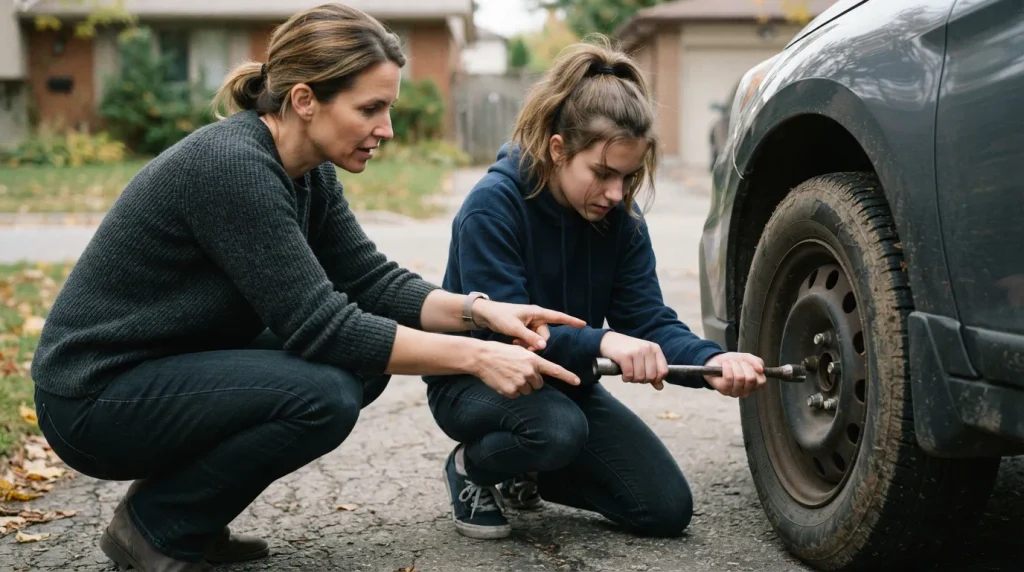
My husband taught our older daughter to change a tire in a Target parking lot when she was fifteen, mostly because our car had a flat and he refused to just do it himself while she watched. She was annoyed the entire time. Two years later she brought it up unprompted, proud, like it had been her idea. Teaching a real skill — cooking, budgeting, basic car maintenance, whatever you’ve got — gives her proof of competence that no amount of “you’re so capable, honey” will ever match.
3. Try a Sport Where the Point Isn’t How She Looks
Rock climbing, martial arts, rowing, weightlifting — anything where the measure of success is “did I get up the wall” rather than “do I look good doing it.” My niece started bouldering at fourteen after years of dance classes that left her hyper-aware of every mirror in the room, and the difference in how she talks about her body now is honestly kind of startling.
4. Sit Down and Actually Look at Her Feed With Her
Not to police it. To ask, out loud, “Does this account make you feel good, or kind of bad, after you scroll it?” Let her be the one who decides what stays and what gets the unfollow. I did this with my daughter over pizza on a random Tuesday and she ended up muting three accounts I never would have guessed bothered her — none of them were the ones I expected.
5. Go Volunteer Somewhere Neither of You Wants to Go
This sounds harsh, I know. But there’s something about doing something slightly uncomfortable — serving food at a shelter, walking dogs nobody wants to adopt, tutoring a kid who’d rather be anywhere else — that yanks a teenager out of her own head for two hours. My daughter complained the entire drive to the food bank the first time. She asked to go back the following month without being asked.
6. Ask Two Questions Every Night, Every Single Night
“Best part of today?” and “What was hard?” That’s it. No lecture, no follow-up interrogation if she gives a one-word answer. We do this in the car, not at the dinner table, because something about not making eye contact makes teenagers talk more. I don’t know why. It just works.
7. Give Her a Creative Outlet With Zero Audience
A notebook nobody reads. A guitar she plays badly in her room with the door shut. A sketchbook that never touches Instagram. The pressure of an audience — even a small, kind one — changes how a teenager creates. Making something purely because she feels like it is a different muscle entirely, and it’s one worth protecting.
8. Start a Compliment Habit That Has Nothing to Do With Looks
If she’s got a close friend group, float the idea of texting each other one genuine compliment a week that isn’t about appearance. “You always make people feel included” instead of “you look so pretty today.” It feels a little forced at first — most good habits do — but it quietly retrains what a girl notices and values in the people around her, herself included.
9. Let Her Fail at Something That Doesn’t Matter Much
This is the hardest one on this list, at least for me. When my younger daughter burned an entire batch of cookies for a bake sale and wanted me to just fix it, I made myself sit on my hands. She remade them, worse the second time, fine the third. Nobody died. She learned she could mess up and try again, which is a lesson you cannot lecture a kid into — she has to actually live it.
10. Sign Her Up for Debate, Speech, or Anything That Forces Her to Talk in Front of People
It doesn’t have to be formal. A presentation at school works. So does making her order for the whole family at a restaurant. The discomfort of using your own voice out loud, in front of people who might disagree, is exactly the discomfort that builds real confidence — not the fake kind that comes from being told she’s great.
11. Take Her Somewhere Neither of You Has Ever Been
New trail, new neighborhood, a hole-in-the-wall restaurant you found on a whim. Practicing being somewhere unfamiliar and figuring it out together builds a kind of adaptability that carries over into every other unfamiliar situation she’ll face — a new school, a new job, a first apartment.
12. Tell Her About Your Own Teenage Insecurities — Actually Tell Her
Not the sanitized version. Tell her about the time you cried in a bathroom stall because someone made fun of your jeans, or the year you were convinced your nose was too big and it colored every school photo you have. This is, in my opinion, one of the most underrated tools on this entire list. It tells her the feeling passes. It also tells her you actually remember what this age feels like, which matters more to teenagers than we give it credit for.
13. Let Her Save Up for Something Dumb and Small
Concert tickets. A pair of shoes she doesn’t need. Whatever it is, tracking her own progress toward something she picked herself teaches delayed gratification and self-trust in a way allowance-for-chores never quite does. My daughter saved for four months for concert tickets and talked about that show for a year afterward — longer, honestly, than she talked about the concert itself.
14. Practice Saying No Out Loud, Before She Needs To
Role-play it. Actually say the words in the kitchen: “No, I don’t want to go to that party,” or “I’m not comfortable with that.” It feels silly doing it as a drill. It’s a lot less silly the first time she uses it for real, with a friend, at fifteen, and it comes out steady instead of shaky.
15. Move Her Body in a Way That Isn’t About Fixing It
Yoga, dancing around the kitchen to bad pop music, a long walk with headphones in. The goal isn’t fitness or appearance — it’s just being in her body instead of evaluating it from the outside, which is where most teenage girls spend way too much of their time.
16. Let Her Start Something Small That’s Entirely Hers
A little Etsy shop selling stickers. A neighborhood cleanup she organizes herself, badly, with a flyer she made in Canva. A blog nobody reads but her. The size of the project matters less than the fact that she built it, start to finish, without you doing the hard parts for her.
17. Read or Watch Something With a Girl Who’s Actually a Mess
Not the impossibly put-together heroine. The funny, flawed, occasionally-a-jerk kind of character. Afterward, ask what she liked about her — it’s a low-pressure way into a conversation about identity that a direct “how are you feeling about yourself lately” question would kill in about two seconds.
18. Put Up a Wall of Small Wins
A corkboard, a stretch of wall by her desk, whatever. Pin the good grade, the kind note from a friend, the ticket stub from something she planned herself. It sounds almost too simple to matter. It matters. Teenagers are terrible at remembering their own history, and a visual reminder does something a pep talk can’t.

19. Practice Taking Feedback on Something Low-Stakes
A recipe, a piece of writing, an outfit she’s picking for photos. Ask her to give it to you honestly, and ask her to take it from you the same way. Learning that criticism isn’t the same thing as rejection is one of the most useful self-esteem activities for teen girls heading toward a world — college, jobs, relationships — where feedback never stops coming.
20. Talk Less. Listen More.
Sometimes the actual activity is doing nothing at all — just sitting next to her while she talks through a bad day without jumping in to fix it, fix her, or fix the situation. Being heard without being managed builds a kind of self-worth I don’t think any structured activity on this list can fully replace.
Frequently Asked Questions
At what age should I start focusing on my daughter’s self-esteem? Earlier than you’d think, honestly, but it’s never too late. The tween and early teen years — roughly ten to fifteen — tend to be when identity and body image pressures hit hardest. That said, I know parents who started this work with a seventeen-year-old and still saw real change within a semester.
What are the signs my teen is actually struggling, versus just being a teenager? Look for patterns, not moments. Constant negative self-talk, avoiding things she used to like, over-apologizing, brushing off every compliment, or endless comparison to friends online — especially if it’s been going on for weeks and is affecting her sleep or appetite. That’s worth a conversation with her pediatrician, not just a pep talk from you.
She rolls her eyes at anything that smells like a “confidence exercise.” Now what? Drop the label completely. Don’t announce it. Just go cook the thing, take the hike, show up at the food bank. Teenagers resist anything that feels like a lesson in disguise. They’ll often show up for the shared experience without ever clocking what it’s actually doing.
How long before I actually see a difference? There’s no clean timeline, and it won’t be a straight line. Some girls shift in weeks. For others it’s a slow year-long build with setbacks in between. Consistency beats intensity here — one great conversation won’t undo months of comparison culture, but showing up regularly will chip away at it.
Is social media really as bad as people say? It’s not that simple. Passive scrolling through curated, filtered content tends to correlate with worse mood and body image. Actually using the apps to connect — messaging friends, sharing her own work — tends to do a lot less damage. That’s why sitting down and curating her feed together matters more than an outright ban ever will.
What if my own relationship with my body or self-esteem isn’t exactly a model to follow? You can still help her, and your honesty about that struggle might do more good than a fake, polished version of yourself. Kids notice when what you say doesn’t match how you act. You don’t need to have it figured out. You just need to be honestly still working on it — that’s a lesson a “perfect” example could never teach her.
A Final Thought
None of this will fix anything overnight, and I’d be lying if I told you otherwise. Confidence gets built in layers, on ordinary Tuesdays, through small moments of being trusted, tried, and actually seen by the people around her. Pick two or three of these that genuinely fit your daughter’s personality — not the ones that sound best written down — and let the rest go. She’ll show you, in her own quiet way, which ones are working.