
Real, tested strategies (and a few honest failures) for getting kids to listen without yelling — from a parent of two, not a script.
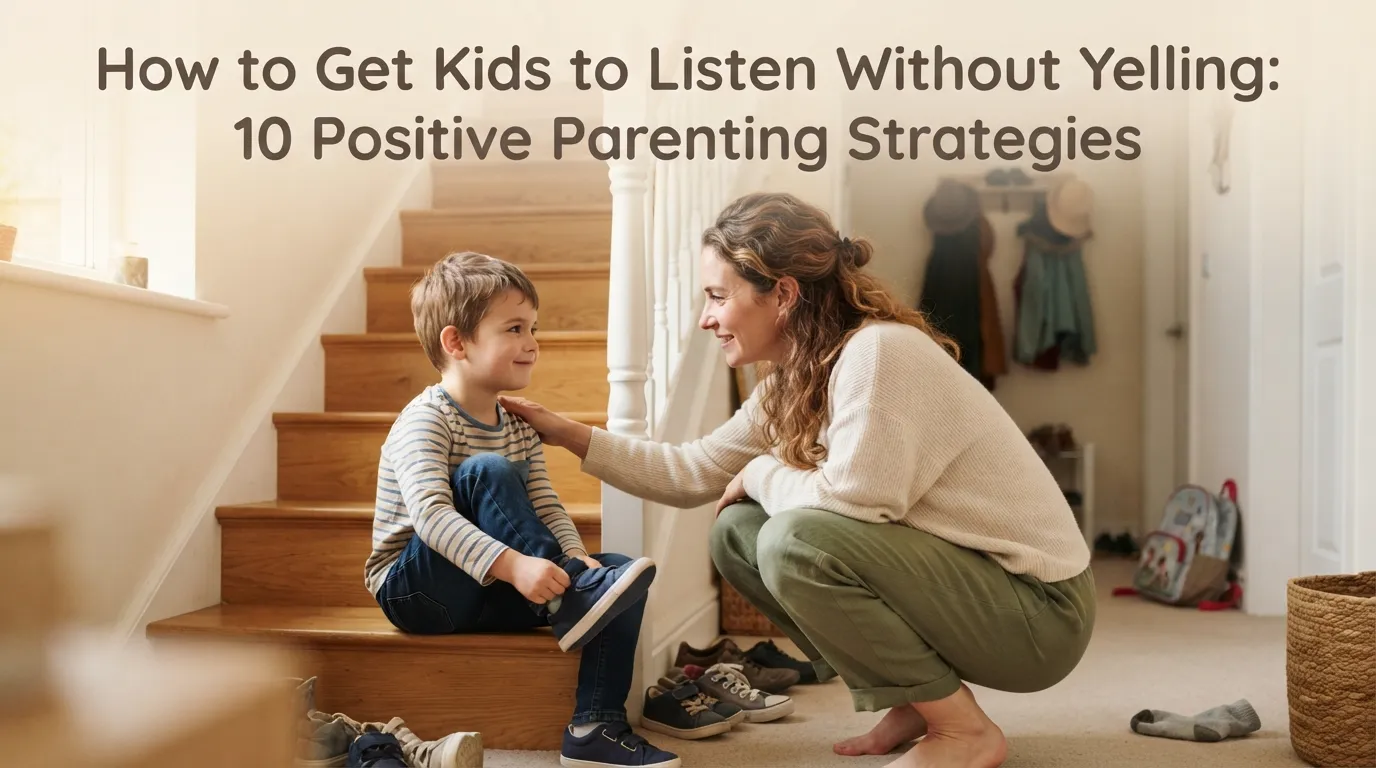
My son Theo is seven, and there was a solid stretch last winter where I said “put your shoes on” so many times before school that I started saying it in my sleep. My husband can confirm this. I’d ask nicely. Then less nicely. By the fourth ask I was standing at the bottom of the stairs doing the voice — you know the voice — while Theo sat on his bedroom floor, fully absorbed in reorganizing his Pokémon cards like the school bus wasn’t a real thing that existed.
I used to think this meant he was ignoring me on purpose. Some days he probably was, honestly, because he’s seven and testing limits is basically his full-time job. But most days it wasn’t defiance. It was that yelling had become background noise in our house, and kids get remarkably good at tuning out background noise. I had to actually change what I was doing, not just get louder at doing it.
So here’s what’s genuinely worked for us — not a list I found somewhere, just things I’ve tested on my own two kids (Theo, 7, and Ivy, 4) over a few rough years.
1. Walk over there. Don’t shout across the house.
I resisted this one for a long time because, frankly, walking upstairs eight times a morning sounds exhausting. But shouting from the kitchen almost never worked, and I was doing it anyway, which meant I was putting in the effort of yelling without getting the payoff of being heard. Backwards.
Now I go to Theo, crouch down, and say his name once before I say anything else. “Theo. Hey, look at me a sec.” It feels slower in the moment. It’s actually faster, because I’m not repeating myself six times from two rooms away.
2. Tell them what TO do — the “don’t” part barely registers
This one sounded like fluffy parenting-book nonsense to me until I actually paid attention to what happened when I said “stop yelling” versus “let’s use inside voices.” The first one, Ivy just… kept yelling, usually louder, like she was arguing the point. The second one actually changes what she does with her voice.
Kids seem to grab the verb and skip right past “don’t.” So “don’t run” becomes “run” with extra confusion attached. “Walking feet, please” just works better. I still slip and say “stop” when I’m tired — I’m not claiming I’ve got this locked down — but when I remember to flip it, it lands.
3. Give the warning before you need the compliance
Nobody likes being yanked off a swing mid-swing. I wouldn’t like it either if someone just grabbed me off a beach chair with no notice. Ivy has genuinely screamed at pickup because we left with zero warning, and honestly, fair.
Now it’s “five more minutes, then we’re going,” said out loud, sometimes with a countdown on my phone she can see. It’s not magic — she still occasionally melts down — but it’s noticeably less often, and less intense when it does happen.
4. One thing. Just one.
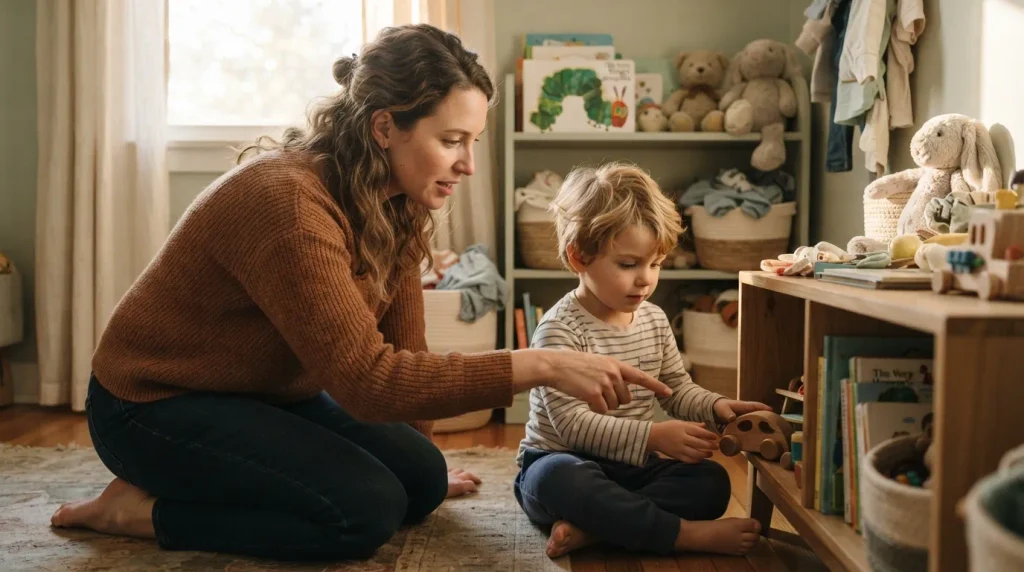
“Brush your teeth, put on pajamas, grab a book” is three jobs disguised as one sentence, and for a four-year-old that’s basically an assignment she didn’t sign up for. I learned this the hard way after asking Ivy to do exactly that and finding her fifteen minutes later, teeth unbrushed, no pajamas, just sitting on the floor with the book, having apparently completed step three and forgotten the other two existed.
Now it’s one instruction, then the next once that’s actually done. Slower some nights. Way less arguing, though.
5. Cut the lecture down to almost nothing
I am, by nature, a talker. My instinct when a kid isn’t listening is to explain further, in more detail, with more feeling behind it. This does not work. It has never once worked. What happens instead is the words turn into a wall of noise that they wait out.
“Backpack. Hook.” gets more done than the three-sentence version of the same request. It feels almost rude to say something that short to my own kid, and yet.
6. Give a real choice, not a fake one
There’s a difference between “do you want to wear the blue shirt or the red one” and “do you want to get dressed or not,” where the second one isn’t actually a choice, it’s a threat with a question mark on it. Kids can tell the difference, even little ones.
With Theo it’s “do you want to put your shoes on yourself, or want help?” Either way the shoes go on. He just gets to feel like he had a say in it, which apparently matters more to a seven-year-old’s cooperation than I expected.
7. Connect for three seconds before you ask for anything
If I’m half-looking at my phone and toss out an instruction without looking up, I basically get nothing back. If I put the phone down, get actual eye contact, maybe touch his shoulder — same instruction lands completely differently. I’ve tested this more than I’d like to admit, mostly by accident, mostly on days I was too tired to think it through and just noticed the pattern afterward.
8. Say the consequence once. Then actually do it.
I went through a phase of saying things like “if you don’t clean this up we’re never coming back to the park,” which is a threat I had zero intention of keeping and both of us knew it. Kids figure out fast which threats are real, and once they know yours aren’t, they stop listening to any of them.
Now it’s smaller and it’s real. “If the blocks aren’t picked up by the time I count to five, I’ll help put them away and we’re done with them for today.” Then I follow through, calmly, without a big speech about it. It’s worked better than any threat ten times its size.
9. Say what they’re feeling before you ask for cooperation
This one felt like a gimmick until it wasn’t. “I know, leaving the park stinks, it’s really fun here” — said before “and we have to go now” — gets me a shockingly different response than skipping straight to the instruction. Not always. Ivy still has days. But often enough that I do it as a first move now instead of a last resort.
10. Notice out loud when it goes right
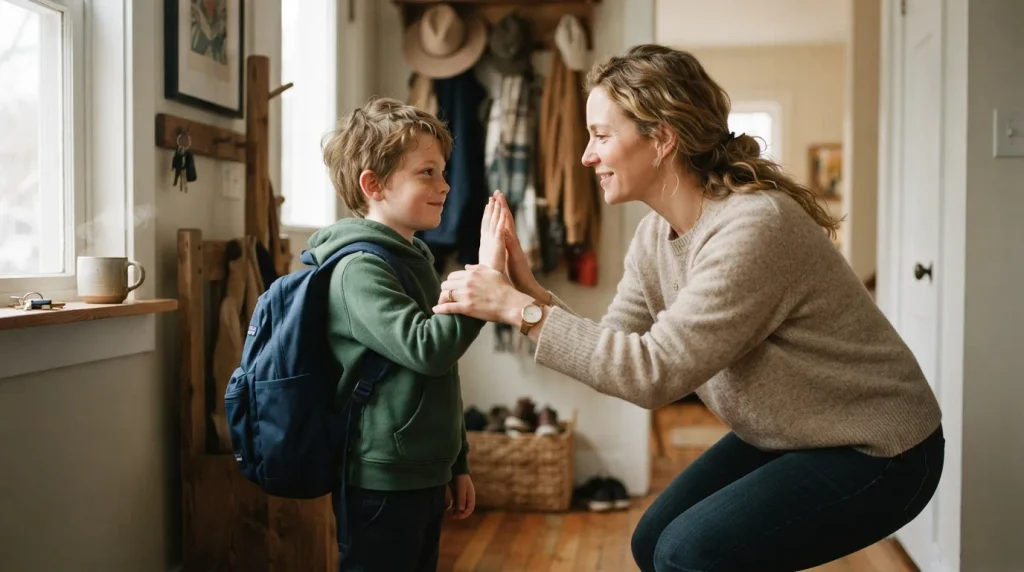
We are all guilty of narrating the bad moments way more than the good ones, because the bad ones are louder and more annoying, and the good ones just… happen quietly and we move on. I started actually saying something when it worked. “Thanks for grabbing your shoes right when I asked, that made this morning so much easier.” Theo visibly perks up when I say this. I don’t fully understand why it works as well as it does. It just does.
A quick, honest note on the yelling itself
I still yell sometimes. Not proud of it, not going to pretend otherwise. There was a morning two weeks ago where I lost it over a missing shoe that turned out to be under the couch the whole time, and I did not handle that gracefully. One bad morning doesn’t erase the rest of it, though. The goal was never to become a parent who never raises her voice — I don’t think that parent exists, and I’d be suspicious of anyone who claimed to be her. The goal is just making the yelling the rare thing instead of the default thing.
Some mornings all ten of these work like a charm. Other mornings we’re still out the door late with one shoe untied and me sounding like a broken record. That’s not failure. That’s just a Tuesday with kids in it.
FAQ
Why does my kid listen for the teacher but not for me?
Teachers get a fresh, low-stakes relationship and one consistent routine repeated for a whole room of kids. You get seven years of history and a kid who feels safe enough to test you specifically. Ironically, that’s usually a sign your relationship is solid, not broken.
When should I expect actual first-time listening?
Somewhere around 7 or 8, multi-step instructions start sticking better. Before that, some repetition is just normal brain development, not a discipline failure on your part.
Does one yelling episode undo all the calm stuff?
No. Pattern matters more than any single bad moment. If calm is your normal and yelling is rare, kids handle that fine.
My kid listens to my partner but not me — why?
Usually it’s about follow-through, not favoritism. Whoever actually enforces the first ask, rather than the fifth, tends to get listened to faster.
What if none of this is working?
Give it a few weeks — kids test whether change is real before they adjust. If nothing shifts, or there’s aggression or major struggles alongside it, loop in your pediatrician.