Simple sensory play ideas for 6-month-old babies using everyday household items, plus safety tips and how long to play. Low-mess and parent-tested.
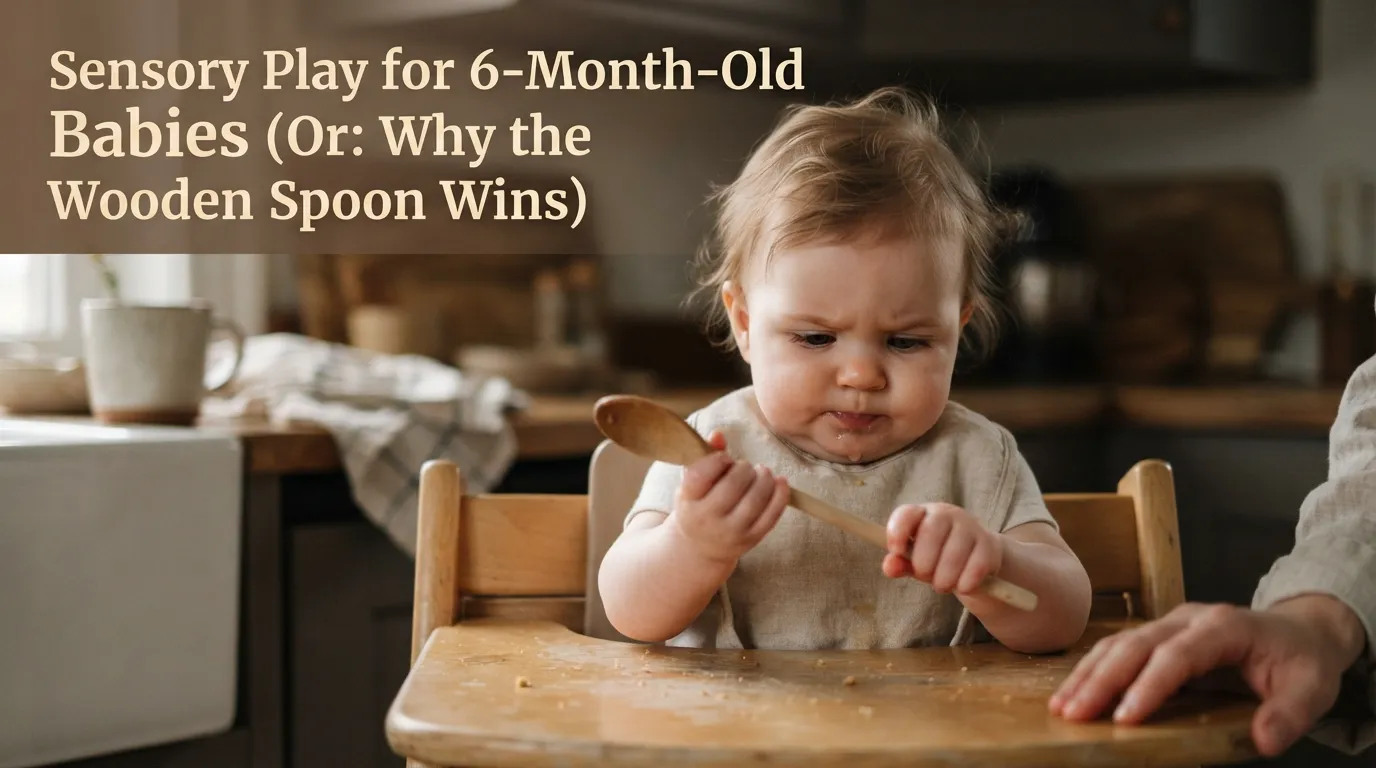
My younger daughter was six months old when I noticed she’d gone quiet in her highchair. Never a good sign. I turned around and found her gumming the handle of a wooden spoon like it owed her money. I looked at the clock. Forty minutes had gone by since I’d handed it over.
Meanwhile, a light-up musical thing my mother-in-law bought sat untouched in the corner, still blinking at nobody.
I’d like to say I planned any of this. I didn’t. With my first, I read everything, bought the tiny bowls, and set up activities with the seriousness of a lab technician. By the second, I was just tired. And the tired version turned out to be better at this.
What’s going on at six months
Somewhere around now, a lot of babies start sitting up, though often with a wobble and a dramatic sideways topple. They reach for things on purpose. They pass a toy from one hand to the other, which feels like a small miracle the first time you see it. And everything, without exception, goes in the mouth.
So when people say “sensory play,” don’t picture a Pinterest board. Picture your baby finding out what a thing feels like, sounds like, and tastes like, in that order or any other. That’s the whole job at this age. You’re mostly there to hand her stuff and make sure she doesn’t choke on it.
Start in the kitchen drawer
I’m going to be bossy here: skip the sensory kit. You’ll spend money on something she’ll like for a week.
Raid your kitchen instead. A wooden spoon, obviously. A silicone spatula, which bends in satisfying ways. A metal whisk, which sounds fantastic against a tray and looks a little menacing but is perfectly fine for babies (just make sure it’s sturdy, with no loose wires). Give her one or two at a time. Hand over the whole drawer and she’ll stare at the pile, then fall apart. I learned that one the loud way.
Washcloths are my other favorite. Wet one, wring it out, and put it in the fridge for twenty minutes or so. A cold cloth on swollen gums is about as popular as anything gets with a teething baby. Hold on to one end yourself so it doesn’t end up wedged in her throat.
If she’s started solids, food counts too. Cooked-and-cooled pasta spirals, a strip of steamed sweet potato, a wedge of ripe avocado that she’ll squish into her own hair. Yes, it’s a mess. Put a splat mat down, strip her to her diaper, and make peace with it. A bath afterward is part of the activity anyway.
Textures, and the face she’ll make
Babies pull a particular expression when they touch something new. It’s a sort of offended squint, like you’ve served her something questionable at a restaurant. Don’t take it as a no. She’s just thinking. Hold the thing near her hands, let her decide, and try again tomorrow if she isn’t interested.
A few things worth trying over a week or two:
- Scraps of fabric laid across a blanket: velvet, corduroy, fleece, something silky. Check for fraying so no threads come loose.
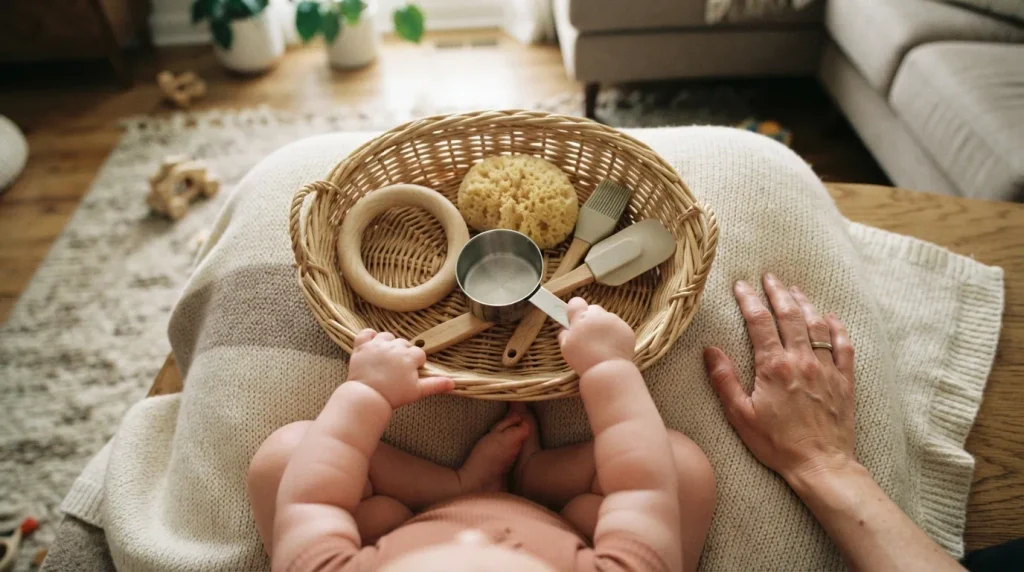
- A “treasure basket,” which is just a shallow basket with five or six safe objects in it. A big wooden ring, a clean sponge, a metal measuring cup, a basting brush with a silicone head. Sit back and watch which one she grabs first. I was wrong every time.
- A baking dish with about an inch of lukewarm water and a plastic cup or two. Stay within arm’s reach, hands ready. Babies can get in trouble in astonishingly little water, and it happens without any noise.
- A blanket on the grass on a warm day, bare feet and all. Drag a leaf across her toes and watch them curl.
Even tummy time improves if you swap the surface now and then. A towel one day, a quilt the next. It’s a small change, but it makes the whole thing feel less like a chore, for her and for you.
Noise, motion, and your own face
Touch gets all the attention, but hearing and balance matter just as much. Babies this age love to cause a sound and then hear it happen.
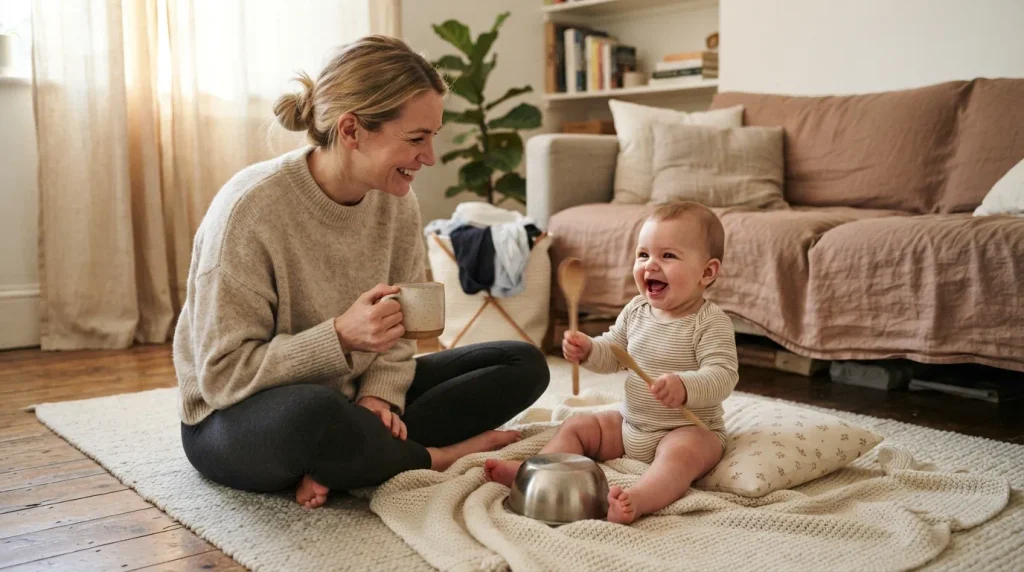
You can make a shaker if you want: a spoonful of dry rice in a small plastic bottle, lid sealed with strong glue and tape so it can’t come off. Check it every few days and throw it out the moment it cracks. Or skip the craft entirely. Drop two wooden blocks in a metal mixing bowl and let her go wild.
Singing, honestly, beats most of it. “Row, Row, Row Your Boat” while you rock her side to side, narrating as you go. “Up we go, and down we go.” You’ll feel silly. She won’t notice, because she’s watching your mouth like it’s the best television she’s ever seen.
A baby-safe mirror is worth the few dollars, too. Hold it at her level and ask who that is. At six months she probably thinks it’s another baby, and the delight on her face when the other baby moves back is hard to beat.
Let her drop things
This one drove me up the wall at first. She’d toss the spoon over the side of the highchair, I’d pick it up, she’d toss it again. I assumed she was testing me.
She wasn’t. She was running an experiment on gravity, and the results kept coming out the same, which is exactly why she kept running it. Now I just say “Down it went!” and hand it back. A few dozen rounds of that and she’s covered cause and effect better than I could ever teach it.
While she plays, name what she’s feeling in short words. “Bumpy. Cold. Soft.” Say it slowly and say it again. It’s how language starts to settle in, and it makes the whole thing feel like time together instead of a task you’re checking off.
The safety bit
I’ll keep this plain, because it matters.
Anything you hand her will go in her mouth, so it has to be too big to swallow, free of small parts that could snap off, and clean. A rough check: if it fits through a toilet paper tube, it’s too small.
Stay in the room with your eyes on her. Glancing at the monitor from the kitchen doesn’t count. Leave out honey, which isn’t safe before age one, and skip whole nuts, whole grapes, and anything hard and round in food play.
Gagging is common while babies figure out solids and usually looks much scarier than it is. Even so, I’d strongly suggest taking an infant first aid class so you know what to do on the rare day it’s more than a gag. And if you’re unsure about a specific food or object, ask your pediatrician. They’ve heard stranger questions.
How long, and how often
Short. Five to fifteen minutes is plenty, and some days you’ll get three before she’s done. Watch for the signs: head turning away, fussing, rubbing her eyes, a kind of glazed look. That’s her telling you she’s finished, and stopping is the right call.
There’s no schedule to keep, either. A few little sessions a week, squeezed between feeds and naps, is plenty. My favorite version was me on the floor with a coffee gone lukewarm and her on a blanket with two spoons.
If she’s just not into it
Some babies are cautious, and mine was, at first, with anything wet or sticky. If yours pulls back, don’t push. Offer the texture beside her instead of on her and let it be boring for a few days. Curiosity tends to arrive on its own schedule.
If she seems truly distressed by everyday things like clothing tags, bathwater, or being touched, or if something about how she reacts to the world just feels off to you, mention it at your next pediatric visit. Most of the time it’s temperament. Occasionally it deserves a conversation, and you’re allowed to trust your gut about which one you’re dealing with.
One last thing
If she ignores everything you carefully set out and goes straight for the cardboard box it came in, well. That’s a normal baby. Mine did that on her first birthday.
Offer a few safe things, stay close, and let her show you what she likes. Then go find that coffee.