
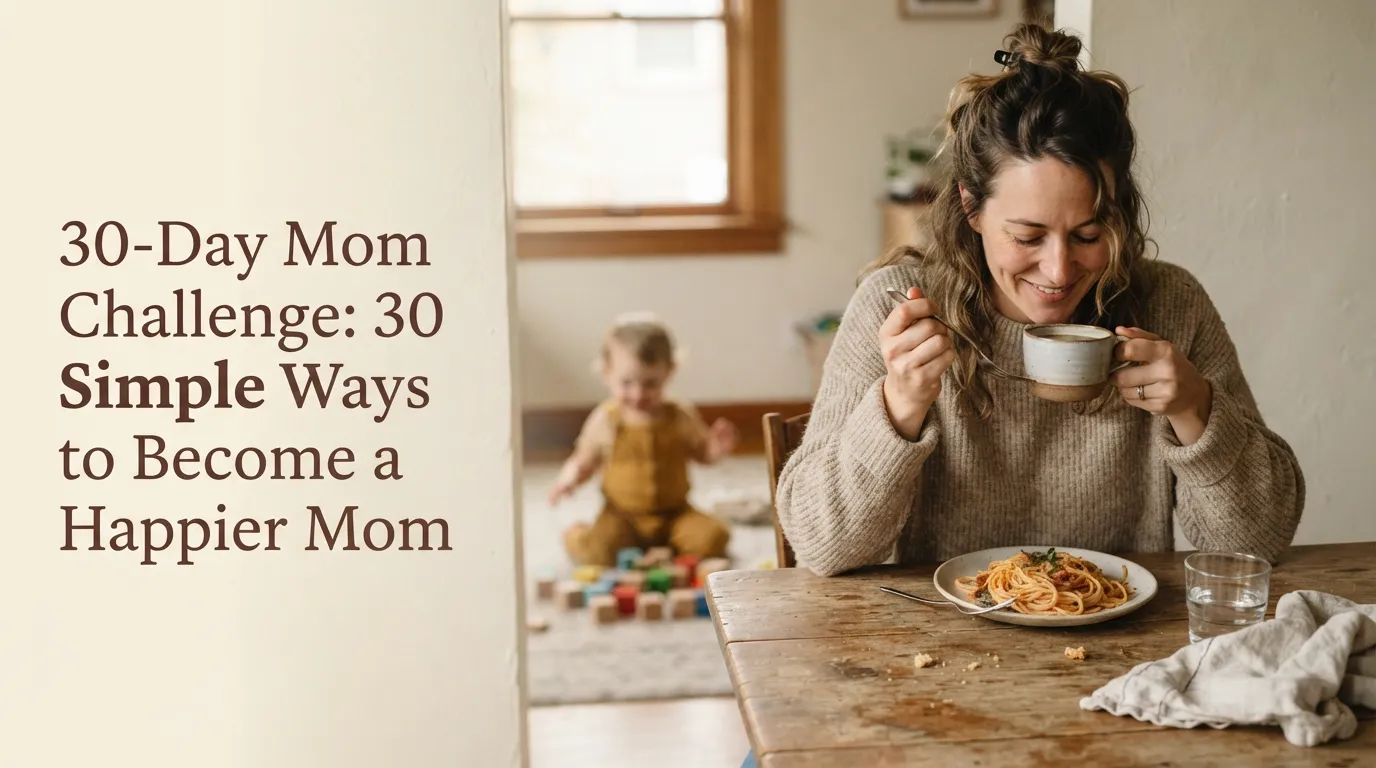
Try this 30-day mom challenge: 30 small, doable ideas to feel calmer, lighter, and more like yourself, one ordinary day at a time.
Last spring I realized I’d eaten lunch standing over the sink for about three weeks straight. Cold pasta, a fork, one eye on the clock. Nobody had told me to do it. I’d quietly decided my needs came last, and then forgot I’d decided.
If that sounds familiar, this challenge is for you. Nothing here requires a spa day, a babysitter, or a personality transplant. Each day is one small thing, and most take under ten minutes. Do them in order, skip around, or repeat your favorites. Becoming a happier mom rarely happens through one big overhaul. It happens in the cracks of an ordinary Tuesday.
A quick note before you start. You don’t have to do all thirty perfectly, and a missed day isn’t a failure. Pick up wherever you left off. The point is to prove to yourself, one small win at a time, that your own wellbeing is worth a few minutes.
Week One: Start Where You Are
The first week is about the basics. Nothing fancy, nothing that needs planning.
Day 1: Sit down for one meal. Take a real plate and a real chair. Even if the kids are climbing on you, you’re eating like a person. I promise the food tastes better when you’re not hovering over a counter.
Day 2: Drink a full glass of water before your coffee. It sounds trivial, and it takes thirty seconds. Most of us run mildly dehydrated for years without noticing, and fixing it can lift the foggy, wrung-out feeling that settles in by mid-morning.
Day 3: Name one thing you did well today. Not a big thing. “I remembered the permission slip” counts, and so does “I didn’t lose it when the milk spilled.” Say it out loud or scribble it on the back of a receipt. Mothers are fast at spotting what went wrong and slow to notice what went right.
Day 4: Lower one standard on purpose. Pick something, like folding towels or matching socks, and decide it’s done enough. Cereal for dinner is not a moral failing. I’ve served it more than once, and my kids are fine.
Day 5: Step outside for five minutes. No phone, no errand. Stand on the porch or walk to the end of the block and back. Daylight and fresh air do more for a bad mood than most of us give them credit for.
Day 6: Text a friend something real. Skip “we should get together soon,” which never leads anywhere. Try “today was rough, tell me something funny.” Friendship runs on small, honest messages far more than on scheduled coffee dates.
Day 7: Do nothing productive for ten minutes. Set a timer and lie on the couch while the dishes watch you. If guilt shows up, let it sit there. It will leave eventually, and the dishes will still be there afterward.
Week Two: Make the Days Run Softer
Week two goes after the friction points, those small daily irritations that quietly drain your patience.
Day 8: Choose tomorrow’s outfit tonight. Do it for yourself, and for the kids too if they’re old enough to cooperate. One fewer decision during the morning chaos is a gift to future you.
Day 9: Build a “good enough” dinner list. Write down five meals you can make half-asleep, such as quesadillas, eggs and toast, or buttered pasta with frozen peas. Stick the list on the fridge. When the five o’clock panic hits, you won’t have to think.
Day 10: Put on music during the worst hour. Every house has one, usually between four and six. Mine got noticeably less tense once I started playing old pop songs through the kitchen speaker. Toddlers will dance, grade-schoolers will sing the wrong words, and teens will pretend not to notice you while quietly noticing.
Day 11: Give yourself a fifteen-minute head start. Wake before the kids, just once, and drink your coffee while it’s still hot. If the thought of an earlier alarm makes you want to cry, skip this one. Not every tip fits every season, and the newborn season especially calls for a hall pass.
Day 12: Say no to one thing. The bake sale, the group chat debate, the third birthday party of the month. A plain “We can’t make it, but thank you for thinking of us” is a complete sentence. You don’t owe anyone a long explanation.
Day 13: Hand off one chore. Let your eight-year-old set the table, or ask your partner to own bath time this week. If it isn’t done exactly your way, let it be. Kids rise to responsibility more often than we expect, and you’ll gain a little breathing room.
Day 14: Clean up your phone. Mute one account or group chat that leaves you feeling behind. Scrolling through other people’s highlight reels while you wipe a counter is a bad trade, and you can make a better one in about ten seconds.
Week Three: Be Kinder to Yourself and Closer to Them
This week is about connection, with your kids and with the voice in your own head.

Day 15: Replace one harsh thought. When you catch yourself thinking “I’m a terrible mother,” try “I’m tired, and I’m still showing up.” The second version is also the more accurate one. You wouldn’t let anyone else talk to you the way you sometimes talk to yourself.
Day 16: Give each child ten minutes of undivided attention. Put your phone in another room and let them choose the activity. A five-year-old will usually pick something wonderfully odd, like building a fort for a stuffed shark. A teenager might simply want you to sit in their room while they play a game. Take it, and don’t comment on the game.
Day 17: Apologize when you blow it. You will yell sometimes. Everyone does. Afterward, get down to their level and say, “I was too loud earlier, and I’m sorry. You didn’t deserve that.” Children learn how to repair a mistake mostly by watching the adults they love do it.
Day 18: Ask one better question. “How was school?” gets you “fine” every time. Try “What made you laugh today?” or “Who did you sit with at lunch?” Teens may still grunt. Keep asking anyway, because the one day they answer will make up for all the grunts.
Day 19: Take one photo of an ordinary moment. The messy kitchen, the mismatched pajamas, the way your son holds his spoon like a shovel. Years from now you’ll treasure those far more than the posed holiday card.
Day 20: Let them see you rest. Kids who watch their mother treat rest as normal tend to grow up treating it that way themselves. Read a book where they can see you, and if they interrupt, calmly say, “I’ll be done in ten minutes.”

Day 21: Forgive yourself for one specific thing. Maybe it’s the missed recital or a snappy morning last week. Write it down, then cross it out. It’s finished, and your kids have almost certainly forgotten it already.
Week Four: Fill Your Own Cup, Properly
By now you’ve built a little momentum. This last stretch is about the bigger stuff, the things that make a lasting difference.
Day 22: Move your body for ten minutes. Walk, stretch, or dance in the kitchen. Choose what feels good rather than what burns the most calories. Movement helps your mood whether or not it changes anything about your body.
Day 23: Go to bed thirty minutes earlier. I know the quiet after bedtime feels sacred and you’re not ready to give it up. I resisted this one for years. Sleep is still the cheapest mood booster you own, and everything looks more manageable after a decent night.
Day 24: Do one thing just because you enjoy it. Sketch, garden, bake something no one asked for, or watch a terrible reality show without apology. Hobbies didn’t stop mattering the day you became a mom.
Day 25: Ask for help out loud. Hints don’t count. “Can you take the kids Saturday morning so I can have two hours?” is clear, kind, and entirely reasonable. Most partners, grandparents, and friends want to help and simply don’t know how.
Day 26: Spend ten minutes with another adult who gets it. A neighbor on the stoop, a sister on the phone, a fellow parent at pickup. Isolation is quietly one of the hardest parts of this job, and ten minutes of honest conversation can loosen it.
Day 27: Clear one small space. A single drawer, the front seat of the car, the corner of the bathroom counter. A tiny patch of order can calm a surprisingly large part of your head.
Day 28: Write down three things that went right this week. Look for specifics rather than generalities. “My daughter hugged me without being asked” beats “the kids were good.”
Day 29: Treat yourself like you’d treat a friend. If a friend told you she’d eaten lunch over the sink for three weeks, you’d be appalled. Be appalled on your own behalf, and then do something about it.
Day 30: Look back and keep what worked. Circle the three days that made the biggest difference and fold them into your regular week. Drop the rest without guilt. The challenge was never about completing a checklist.
What Happens After Day 30
You won’t feel transformed, and that’s fine. What you might notice is smaller: a bit more patience at bedtime, a little less dread at four o’clock, a kitchen chair that’s started to feel like yours.
If you hit a bad stretch, such as weeks of sadness, constant anxiety, or a heaviness that won’t lift, please talk to your doctor. That’s not a challenge you need to win on willpower. Plenty of good mothers need real support, and asking for it is part of taking care of your kids too.
For everyone else, start tomorrow with the sit-down lunch. Your fork has earned a proper plate.
Frequently Asked Questions
What if I miss a day during the 30-day mom challenge?
Just pick up where you left off, or skip ahead to a day that suits your mood. There’s no scoreboard here. A challenge meant to make you happier shouldn’t turn into one more thing to feel guilty about.
Do I have to do the days in order?
No. The weeks are loosely themed, but you can jump around. If Day 25 feels more urgent than Day 4, start there.
How much time does this take each day?
Most days take ten minutes or less, and several take under two. The goal is to fit into the life you already have, not add another job to it.
Can I do this challenge with a newborn or a baby?
Yes, with some flexibility. Skip anything that requires extra energy, like waking up early, and focus on the easy ones: sitting down to eat, drinking water, texting a friend, and asking for help. The newborn stage is survival mode, and that’s enough.
Will this work if my kids are teenagers?
Absolutely. Several days, such as asking better questions, apologizing after a blow-up, and spending ten minutes of undivided time, tend to matter even more with older kids. Just expect fewer words in return and don’t take it personally.
What if I feel sad or overwhelmed even after trying these ideas?
Small habits help with everyday stress, but they aren’t a treatment for depression or anxiety. If low mood, constant worry, or exhaustion lasts more than a couple of weeks, or if it’s getting in the way of daily life, please see your doctor or a mental health professional. Seeking help is a strong, practical thing to do.
Can my partner or a friend join the challenge?
It’s often better that way. Doing it alongside someone gives you a person to text on Day 6 and a reason to follow through on Day 25. Partners can take on the “small things” version too.