
Okay, real talk. Nobody warns you about the exact moment a nurse hands you your baby, smiles, and says “let’s try feeding” — while you’re still numb from the ribs down and terrified to laugh, cough, or sneeze because it feels like your stitches might pop. That was me, hour six after my second C-section, staring at this tiny person and thinking, “I have literally no idea how to hold you without it hurting.”
Nobody tells you that part. Everyone talks about the birth, the recovery timeline, maybe the scar. Almost nobody sits you down beforehand and says “here’s how you’re actually going to feed this baby when you can’t engage your abs for two weeks.” So I’m going to do that for you now, the way I wish someone had done for me.
Quick disclosure before we go further: I’m not a doctor. I’m a mom of two who’s had two C-sections, four years apart, and learned most of this the hard, trial-and-error way — usually at 2 a.m., usually with my husband half-asleep trying to prop pillows in the dark. Take what’s useful, run anything medical by your own OB or a lactation consultant, and toss what doesn’t fit your situation.
Why This Feels So Much Harder Than It Should
Here’s the thing nobody explains well: it’s not that feeding a C-section baby is different. Babies don’t know or care how they arrived. What’s different is you — specifically, the six-inch incision sitting exactly where a baby’s body normally rests when you cradle them the “normal” way.
So the standard cradle hold, the one every baby photo on Pinterest shows? Skip it. For at least the first couple of weeks, it’s going to put pressure right on the spot that hurts the most. I tried it once, day two, out of stubbornness, and immediately regretted it. Lesson learned fast.
The Football Hold Saved My Sanity
This one felt weird the first time I did it — my mother-in-law actually laughed and said I looked like I was tucking a loaf of bread under my arm. But it works. You tuck the baby at your side, facing you, legs pointing back toward the chair or headboard, head resting in your hand at breast height. Zero contact with your belly.
A firm pillow under your arm makes a real difference here, otherwise your bicep gives out around minute fifteen (ask me how I know). This became our default for the first ten days, hands down.
Side-Lying Feeds, Especially for 3 a.m.

I didn’t discover this one until baby number two, and I genuinely wish I’d known about it the first time around. You lie on your side, baby facing you, tummy to tummy, and just… feed like that. It takes some fumbling to get positioned — rolling onto your side after abdominal surgery is its own little event, not gonna lie — but once you’re settled, it’s the closest thing to actual rest you’ll get during a night feed.
Pillow behind your back, one between your knees. That’s it. My husband used to joke our bed looked like a pillow fort built by a toddler with anxiety, and honestly, fair.
Reclined Feeding, When You’re Too Tired to Think About Angles
Some nights you just don’t have it in you to arrange three pillows correctly. On those nights, lean back, let the baby lie chest-down on you, and let gravity do some of the work. Their weight lands on your upper chest, nowhere near your incision.
This was my go-to during the newborn haze, roughly weeks two through five, when I’d stopped counting hours of sleep because the number was too depressing.
Set Up Camp Before You Need It
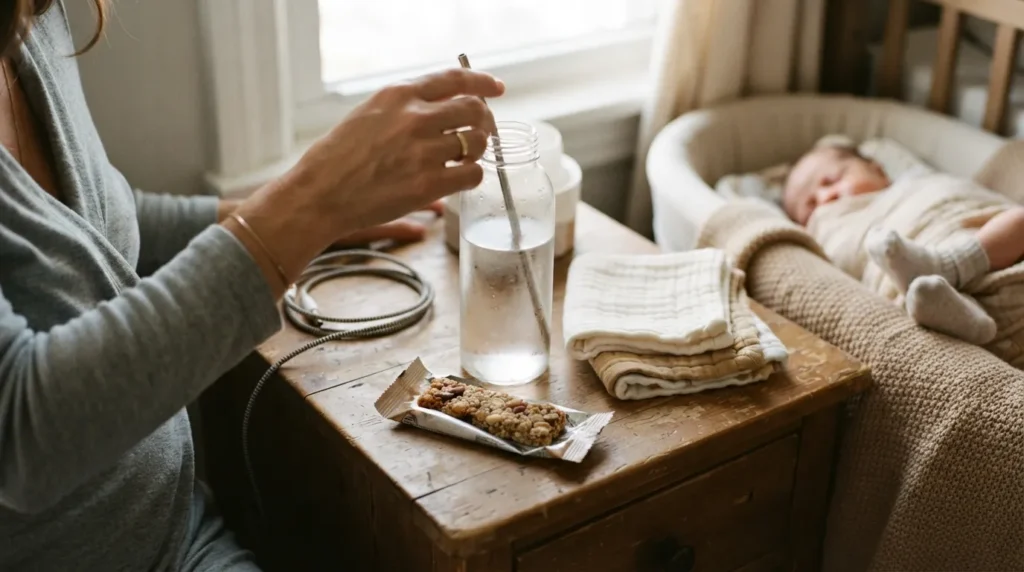
This sounds obvious until you’re the one hobbling to the kitchen for a water bottle mid-feed with a baby latched and screaming behind you. Set up your spot — bed, recliner, wherever — before you’re too sore to move around easily.
What actually earned its place in mine:
- A big water bottle, the kind with a straw, because breastfeeding makes you absurdly thirsty
- One-handed snacks — granola bars, not anything requiring a fork
- Burp cloths, more than feels necessary
- My phone charger, always dying at the worst moment
- Nipple cream, if you’re nursing
- A spare onesie, because there will be a blowout eventually and it’s never convenient
Ask whoever’s around to restock it once a day. My mom did this for us during her visit and it honestly felt like a small miracle every morning.
Take the Pain Medication. Seriously.
I get the instinct to white-knuckle through it, especially if you’re breastfeeding and worried about anything reaching the baby. Talk to your doctor about your specific meds, but generally speaking, staying ahead of your pain schedule makes feeding easier, not harder. Pain makes your whole body tense, and tense muscles do not want to hold a feeding position for twenty minutes.
I started timing my medication about half an hour before a feed once I figured this out, and it made a noticeable difference. Wish I’d started that on day one instead of day four.
If Breastfeeding Isn’t Clicking, You’re Not Doing It Wrong
Milk can take a little longer to come in after a C-section, especially with a scheduled surgery where labor never really got going. That happened to me both times. It’s common, and it doesn’t mean anything’s wrong with you or your supply long-term.
If the latch feels like a battle every time, ask for a lactation consultant before you’re discharged. Most hospitals have one on staff, and the wait is worth it. And if you end up formula feeding, or combining the two, none of the positioning tips above stop mattering — a bottle-fed baby still deserves a mom who isn’t wincing through every feed.
There’s no medal for pushing through pain to prove some kind of point. I promise nobody’s keeping score except you.
Let People Actually Help You
If someone offers to bring the baby over, grab a pillow, refill your water — say yes. I know it feels strange to need help with something as basic as sitting down to feed your own kid. It felt strange to me too, both times, and I still said yes anyway because pride doesn’t heal an incision any faster.
Show your partner the football hold and the side-lying setup, even if you’re the one nursing. Just knowing someone else understands the mechanics takes some of the weight off you being the only one who “gets it.”
It Won’t Feel This Awkward Forever
Recovery from a C-section runs on its own clock, and it’s not a race. Most moms notice a real shift in comfort somewhere around week two or three, though your mileage will vary — mine did, between my two kids, by almost a full week.
Feeding will feel slow and clunky at first, like you’re solving a puzzle every single time. Then one day — I couldn’t tell you exactly which day, because it sneaks up on you — it just isn’t anymore. You’ll find the position that works for your body, the setup that keeps you sane, and it’ll start feeling less like a project and more like just… your life with this new person in it.