

I found out I had gestational diabetes at 27 weeks, sitting in my OB’s parking lot with a half-eaten granola bar in the cup holder, feeling like I’d somehow already messed this up. The nurse had called it in — she was kind about it, but “gestational diabetes” still landed like a gut punch. I remember thinking, okay, so no more carbs, ever, for the next three months? I’m going to be miserable.
That’s not actually how it went. And if you’re reading this fresh off a diagnosis, still a little shaky, I want to tell you what I wish someone had told me: this is manageable, and it doesn’t require you to give up eating like a normal human being. It requires a few habit shifts, some trial and error with your own body, and a little patience while you figure out what your particular blood sugar does and doesn’t like.
Okay, But What Is This, Really
Short version: pregnancy hormones make your body more resistant to insulin. That’s normal, actually — it’s partly how your body makes sure your baby gets enough glucose. For some of us, that resistance goes further than it should, and blood sugar climbs higher than it needs to. That’s gestational diabetes. It typically shows up in the second half of pregnancy, which is why the glucose screening happens around 24 to 28 weeks — right when I got my call.
I’ll say this plainly because I wish someone had said it to me: this isn’t about anything you did wrong. I ate reasonably well before that diagnosis. My mom had it with both her pregnancies too, so genetics were probably working against me from the start. Sometimes it’s just biology being biology.
Your OB or a dietitian will give you specific blood sugar targets and a testing schedule — those numbers are yours, personal to you, and they’re the ones that actually matter day to day. I’m not going to hand you generic numbers here because honestly, that’s not my place, and your provider knows your situation better than any blog post can. What I can tell you is what I learned about food, because that part is mostly universal.
Small and Steady Beats Big and Occasional
Here’s the mental shift that helped me most: stop thinking in three big meals and start thinking in five smaller touchpoints throughout the day — three moderate meals, two or three snacks. I resisted this at first. I like a big dinner. But going long stretches without eating was setting me up for two bad options: either I’d get so hungry I’d overeat at the next meal, or my body would start pulling stored sugar from my liver to compensate, which messed with my numbers in the opposite direction.
The other thing that took me embarrassingly long to internalize: carbs by themselves are the problem, not carbs in general. A slice of toast alone hits your bloodstream fast. That same toast with peanut butter and an egg on the side? Much gentler curve. Protein and fat slow everything down. Fiber does too. So basically, carbs need a chaperone.
Mornings Are a Different Beast
If you take one thing from this post, let it be this: breakfast is the hardest meal of the day for almost everyone with gestational diabetes, and it’s not you doing something wrong. Insulin resistance tends to peak first thing in the morning, so foods that would be totally fine for you at 1 p.m. can spike you badly at 7 a.m.
I learned this the hard way with oatmeal. Oatmeal! The “healthy” breakfast! My numbers came back higher than I’d seen all week, and I remember feeling almost betrayed. Turns out oats, eaten plain, digest fast enough to cause a real spike for a lot of people with GD, even though they’re perfectly fine outside of pregnancy or later in the day.
What worked for me, most mornings:
- Two eggs with spinach, and if I wanted toast, one slice, not two
- Plain Greek yogurt with a small handful of walnuts and a few berries — never the flavored yogurt, which is basically dessert with a health halo
- A cheese and veggie omelet with half an avocado on the side
- Cottage cheese with cucumber and a couple whole grain crackers, which sounds odd but grew on me fast
Juice, sugary cereal, muffins, and plain fruit-heavy breakfasts were pretty much off my morning rotation entirely. Not forbidden forever — just not a smart bet before 9 a.m.
Lunch and Dinner Without a Spreadsheet
I am not a carb-counting, food-scale-owning kind of person, and I never became one during those months. What worked instead was a simple visual: half my plate vegetables, a quarter protein, a quarter carbohydrate — and making that carb something whole, like quinoa or a sweet potato, rather than something white and refined.
Some combinations that became regulars in my house:
- Grilled chicken, roasted broccoli, a small scoop of quinoa
- Salmon with a big olive-oil-dressed salad and half a sweet potato
- Turkey chili loaded with beans and vegetables — one of the few meals my toddler would also eat without a fight, which felt like a small miracle
- Beef and vegetable stir-fry with a modest scoop of brown rice, heavy on the vegetables
Pasta and rice weren’t banned from my kitchen. I just stopped eating them the way I used to — a huge bowl of pasta with basically no protein in sight. A cup of pasta with grilled chicken and a side salad behaves nothing like a giant bowl of plain noodles with sauce, even though the pasta itself is the same.
Snacks Are Not Optional, They’re Strategy
I used to think of snacking as a bit of a failure, like I should just be able to make it to the next meal. Gestational diabetes flipped that completely — snacks became one of my main tools for keeping blood sugar from swinging too far in either direction.
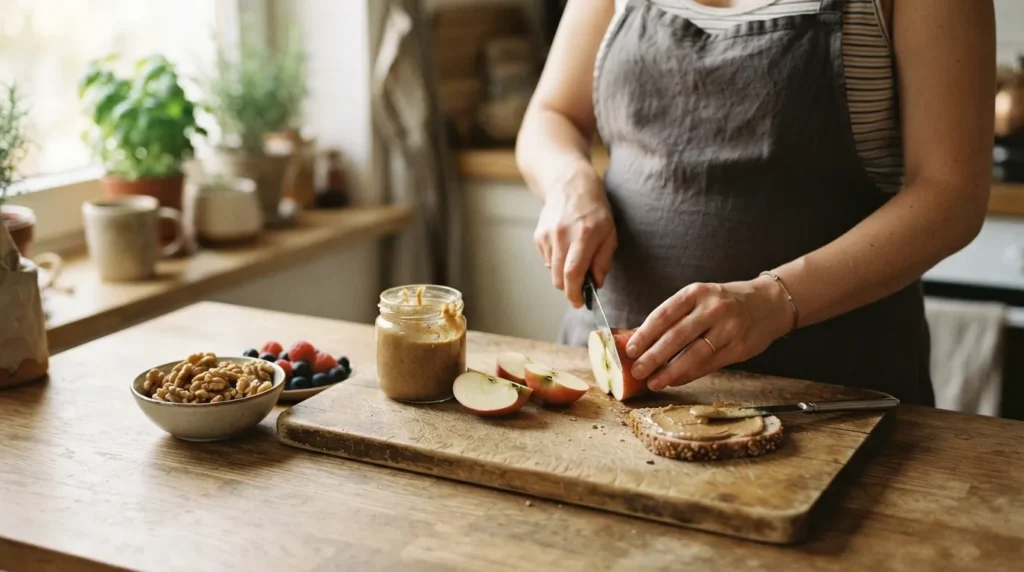
Things I kept stocked in my fridge and bag constantly:
- An apple with a spoonful of almond butter
- A small handful of almonds with a few whole grain crackers
- String cheese and a small bunch of grapes
- Hummus with cucumber and bell pepper strips
- A hard-boiled egg with a handful of berries
The bedtime snack surprised me most. I skipped it the first week, figuring I didn’t need to eat right before sleep, and my fasting numbers the next morning were higher than any other reading. Turns out going too long overnight makes your liver release stored sugar to keep you steady, which can push your morning number up. A little cheese and crackers, or a spoonful of peanut butter, before bed fixed that almost immediately.
What I Actually Cut Back On
Not eliminated. Cut back. There’s a difference, and nobody needs to feel like they’re on lockdown for three months.
- Juice, including the “100% natural” kind — it moves through your system almost as fast as soda does
- White bread and white rice eaten on their own, without protein alongside
- Pastries and cookies, especially on an empty stomach, which is basically asking for a spike
- Big handfuls of dried fruit — it’s deceptively concentrated, way more sugar per bite than fresh fruit
I still had a cookie now and then. One cookie, after a meal, with protein already in my system, was a very different experience than three cookies on an empty stomach at 3 p.m. Context mattered more than the food itself.
The Walk After Dinner Thing Actually Works
I was skeptical about this one. A ten or fifteen minute walk after eating sounded like one of those tips that gets repeated because it sounds sensible, not because it does much. I was wrong. My husband and I started walking around the block after dinner most nights, and my post-meal numbers noticeably improved compared to the nights we skipped it.

The mechanism is simple enough — active muscles pull glucose out of your bloodstream to use as fuel, which lowers the spike from whatever you just ate. If an actual walk isn’t in the cards some nights, even puttering around the kitchen instead of sitting straight down on the couch seems to help a little.
Some Days the Numbers Just Won’t Cooperate
I want to be honest about this part because I don’t see it said enough: some days you’ll do everything “right” and still get a number that annoys you. Stress does it. A bad night of sleep does it. Being sick does it. Sometimes I never figured out why a number was off, and I stopped trying to solve every single one like a mystery novel.
One high reading is not a failure and it’s not a crisis. It’s just data. Write it down, notice if it becomes a pattern, and mention it to your provider at your next check-in. That’s the whole job.
Gestational diabetes almost always resolves after your baby arrives. But I’ll tell you a little secret — a lot of the habits I picked up during those months stuck around long after. My kids are older now, and I still default to protein-plus-carb snacks and post-dinner walks, mostly because they made me feel steadier, not just because a doctor once told me to. You’re not just getting through a diagnosis. You’re building a way of eating that’s honestly pretty solid for anyone, pregnant or not.